Why Some Train Horns Are Louder Than Others: Trumpet Size & Hz
Trumpet length sets a train horn's pitch in Hz, while air pressure and airflow set the decibels. The physics of why one kit hits 147.7 dB and another stops at 130.
Put two chrome four-trumpet train horns side by side and one can bury the other by nearly 20 dB, even though they look almost identical. Why some train horns are louder than others comes down to air pressure, airflow, and diaphragm quality — while trumpet size controls something different: the frequency in Hz.
Volume and pitch are two separate jobs
The most common assumption buyers make is that bigger trumpets automatically mean a louder horn. The physics says otherwise. As HornBlasters puts it in their technical guide: flare size and horn length control pitch, not volume. Longer, wider trumpets produce deeper tones; shorter, narrower trumpets produce higher-pitched sound.
So when you’re comparing horns, you’re really evaluating two independent systems:
- Loudness (dB) — set by air pressure, airflow, and how much air the diaphragm can move per cycle
- Pitch (Hz) — set by trumpet length and flare geometry
- Perceived “bigness” — set by how low the fundamentals sit and how many notes stack into the chord
A horn that nails all three sounds like a locomotive. A horn that only chases the dB number sounds like a loud toy.
How the sound gets made in the first place
Every trumpet on a train horn hides a diaphragm inside its power chamber. Per Wikipedia’s train horn entry, pressurized air flowing past the diaphragm makes it oscillate against the nozzle — deflecting, releasing a puff of air into the bell, and reseating hundreds of times per second. That oscillation rate is the note you hear, and we break the whole mechanism down in our explainer on how train horns work.
This is also where build quality quietly decides loudness and lifespan. Premium horns use stainless-steel diaphragms; budget imports often use plastic diaphragms that warp, bend, or crack after limited use, according to HornBlasters. A warped diaphragm seals poorly, wastes air, and loses output long before the trumpets themselves show any wear. The Shocker XL, for example, pairs fiberglass-reinforced ABS bells with stainless-steel and brass internals — the parts you can’t see are the parts doing the work.
Trumpet length sets the Hz
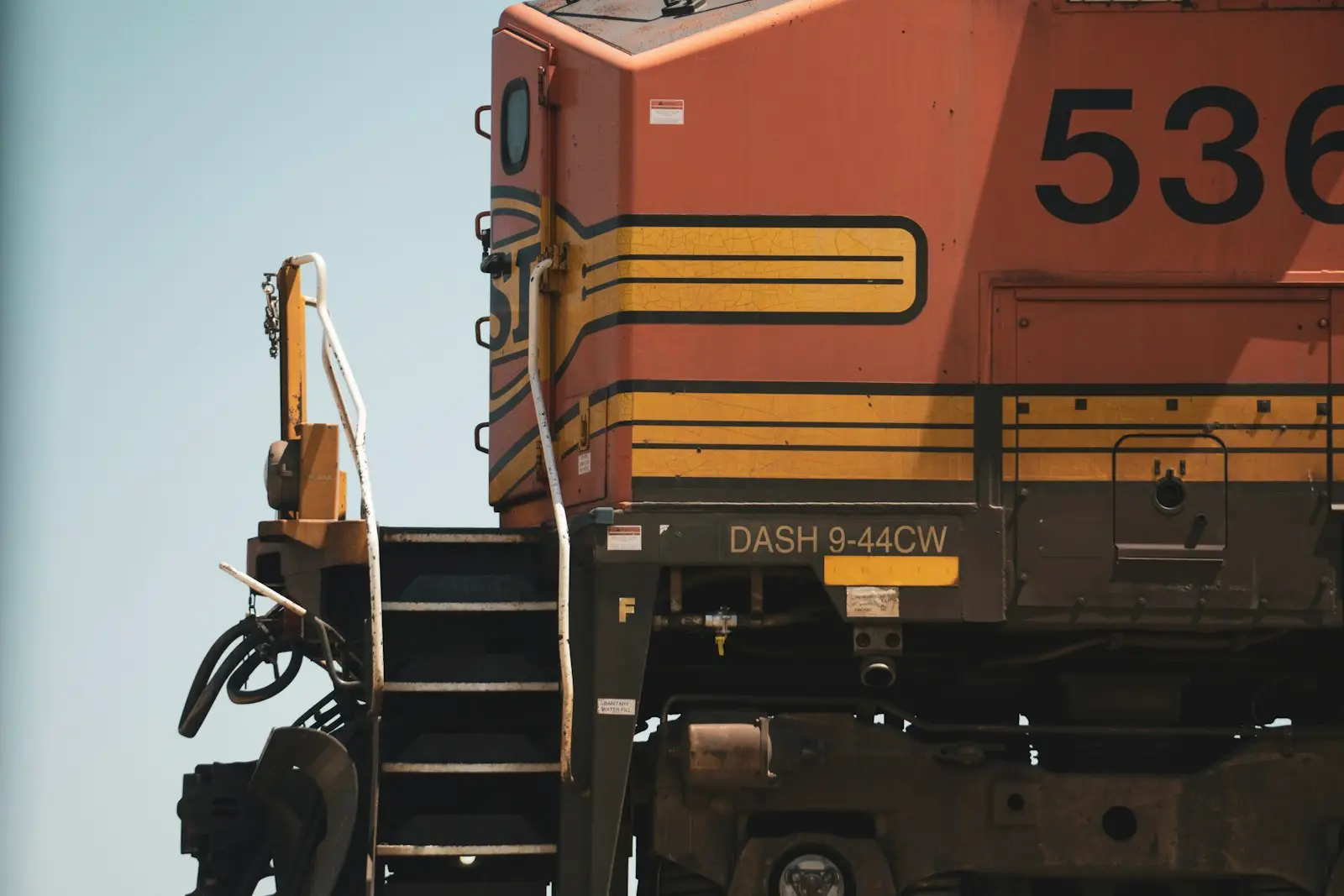
The rule from locomotive horn design is simple: the longer the bell, the lower the note. Bell length (along with thickness and diameter) determines the fundamental frequency, which is why the trumpets on any multi-trumpet horn are visibly different lengths — each one is cut to speak one specific note of the chord.
| Horn class | Fundamental frequencies |
|---|---|
| Real locomotive horns (typical) | ~277–494 Hz |
| Nathan AirChime K5LA (5 bells) | 311–622 Hz (D#4 to D#5) |
| Wolo 853 Philly Express (4 trumpets) | 290 / 421 / 548 / 648 Hz |
| Budget “imitation” train horns | 740–1,975 Hz |
The Nathan K5LA — the classic Amtrak-era horn developed in 1975 — plays a B major 6th chord (D#, F#, G#, B, D#) with its lowest bell at 311 Hz. Getting a fundamental that low takes serious hardware: the longest bell on a HornBlasters Shocker XL runs 19.50 inches. Meanwhile, the cheap horns sitting in the 740–1,975 Hz range sound thin and honky no matter what dB number is printed on the box, because pitch — not volume — is what your brain uses to size up the sound source. If you want the full story on why those notes are chosen, see our guide to train horn chords and trumpet tuning.
Air pressure and airflow: where loudness actually comes from
If trumpet size is the instrument, air is the lungs. Real locomotive horns run on the train’s main air reservoir at roughly 125–140 PSI. Aftermarket kits span a wide range — HornBlasters’ guide cites 120–200 PSI systems for serious setups — and where a horn sits in that range tracks closely with its output.
Two real products make the point:
- Wolo 853-800 Philly Express PRO
- 130 dB, operating at 90/110 PSI
- HornBlasters Shocker XL
- 147.7 dB, rated to 150 PSI max working pressure
Higher pressure drives the diaphragm harder and pushes more air through the bell on every cycle — and moving more air is, at bottom, what loudness is. That 17.7 dB gap is enormous: on the decibel scale, every 10 dB is roughly a doubling of perceived loudness, which we unpack in our guide to decibels and how loud 150 dB really is. Airflow matters just as much as peak pressure: a horn fed through an undersized air line or a nearly empty tank will sag in both pitch and volume mid-blast, because the diaphragm is starving.
The flare is an amplifier — and size still matters
So if trumpet size doesn’t set volume, why are the deepest, most impressive horns always physically huge? Because the flared bell is an acoustic transformer. Per the acoustics literature, a horn provides an impedance match between the sound source and free air, which maximizes the efficiency of transferring sound into the atmosphere — and the flare also radiates harmonics in the range where the ear is most sensitive.
The catch is that low frequencies have long wavelengths, and a horn mouth has to be large relative to the wavelength to radiate it efficiently. The textbook example: a circular horn mouth sized to properly reproduce 20 Hz would be about 18 feet across. Train horns don’t go anywhere near that low, but the principle scales — a 311 Hz fundamental needs a long bell with a wide mouth to leave the horn with authority. That’s the real reason compact horns can’t fake freight-train bass: it’s not that small trumpets are quiet, it’s that they physically cannot couple low notes to the air.
The dB(A) trap: why deep horns measure “quieter” than they sound
Here’s a wrinkle that trips up spec-sheet shoppers. Nearly all sound measurements are A-weighted — dB(A) — which deliberately discounts low frequencies because the human ear is less sensitive to them. Two horns can hit the same meter reading while the deeper one subjectively sounds far bigger, carries farther, and produces that chest-thump sensation the meter never sees.
Even the federal government measures locomotive horns this way: under 49 CFR 229.129, a locomotive horn must produce a minimum of 96 dB(A) and a maximum of 110 dB(A) measured 100 feet forward of the locomotive. Note the distance — 100 feet, not the 3 feet most aftermarket brands use. Any time you compare two horns’ numbers, check the test distance and the weighting first, or you’re comparing apples to freight cars.
The real-world loudness ladder
Putting verified numbers side by side shows how the tiers actually stack up:
| Sound source | Measured output |
|---|---|
| Typical electric car horns | ~120 dB |
| Wolo 853 Philly Express | 130 dB (at 90/110 PSI) |
| HornBlasters Bullet air horn | 145.8 dB |
| HornBlasters Shocker XL | 147.7 dB |
| Nathan AirChime K5LA (real locomotive horn) | 149.4 dB |
The Nathan K5LA’s 149.4 dB, measured in independent lab testing cited by HornBlasters, is the practical ceiling — a real cast-metal locomotive horn on full reservoir pressure. That’s why you should treat bigger advertised numbers with suspicion:
- Claims of 160+ dB have no basis — as HornBlasters bluntly puts it, there is no such thing as a 160+ decibel horn
- Claims above ~150 dB usually come from close-throat measurements at undisclosed distances
- A dB number without a stated distance and PSI is marketing, not measurement
For the honest ranking of what’s actually loud, see the loudest train horns in the world, and for why spec sheets inflate, read advertised vs real-world decibels.
Keep reading
- Decibels explained: how loud is 150 dB really?
- The loudest train horns in the world (2026 ranking)
- How do train horns work? Complete explanation
- Why train horns make a chord: tuning & harmonics
- Nathan AirChime K5LA review
Sources
- Wikipedia — Train horn — diaphragm/power-chamber sound mechanism, 125–140 PSI locomotive operating pressure, “the longer the bell, the lower the note”
- Cornell LII — 49 CFR § 229.129 — federal locomotive horn requirement of 96–110 dB(A) measured 100 feet forward of the locomotive
- Wikipedia — Horn (acoustic) — impedance matching between source and free air, ~18 ft mouth needed for 20 Hz, flare efficiency in the ear’s sensitive range
- Wikipedia — A-weighting — dB(A) discounts low frequencies to match reduced human ear sensitivity
- Wikipedia — Nathan Manufacturing — K5LA B major 6th chord (D#, F#, G#, B, D#), bell frequencies 311–622 Hz, 1975 Amtrak development history
- HornBlasters — Train Horn Guide — “flare size and horn length control pitch, not volume”, 277–494 Hz real-horn fundamentals, 740–1975 Hz imitation horns, 120–200 PSI systems, stainless vs plastic diaphragms, “no such thing as a 160+ decibel horn”
- HornBlasters — How Loud Are Your Train Horns? — 149.4 dB Nathan AirChime K5LA lab measurement, 145.8 dB Bullet air horn, ~120 dB electric horns, commentary on inflated dB claims
- HornBlasters — Shocker XL Train Horn product page — 19.50 in longest bell, 150 PSI max working pressure, fiberglass-reinforced ABS / stainless / brass construction
- Amazon — HornBlasters Shocker XL Train Horns listing — 147.7 dB actual measured rating
- Wolo — Model 853-800 Philly Express PRO product page — 130 dB at 90/110 PSI, 290/421/548/648 Hz chord frequencies, horn dimensions
Frequently asked questions
Quick answers to the questions people ask most about this topic.
- Do bigger trumpets make a train horn louder?
- Not directly. Trumpet length and flare size control pitch, not volume — loudness comes from air pressure, airflow, and diaphragm quality. Big trumpets matter because only a long, wide bell can efficiently radiate the deep 277–494 Hz notes that make a horn sound like a real locomotive.
- What frequency (Hz) are real train horns?
- Real locomotive horns typically have fundamentals around 277–494 Hz. The classic Nathan AirChime K5LA plays a B major 6th chord spanning 311 to 622 Hz, while cheap imitation horns sit much higher, around 740–1,975 Hz, which is why they sound thin.
- Does more PSI make a train horn louder?
- Yes, up to the horn's design limit. Higher pressure drives the diaphragm harder and moves more air per cycle — the Wolo 853 produces 130 dB at 90/110 PSI, while the HornBlasters Shocker XL is rated to 150 PSI and measures 147.7 dB. Exceeding a horn's rated pressure risks damaging the diaphragms.
- How loud is the loudest real train horn?
- Independent lab testing cited by HornBlasters measured the Nathan AirChime K5LA, a real cast-metal locomotive horn, at 149.4 dB. That is the practical ceiling — advertised ratings of 160 dB or more have no basis in measurement.
- Why does a deep train horn sound louder than its dB rating suggests?
- Sound meters use A-weighting, which discounts low frequencies because human ears are less sensitive to them. A deep horn can read the same dB(A) as a higher-pitched one while subjectively sounding far bigger and producing chest-thump you feel as much as hear.
Related reviews & guides
Why Train Horns Sound Louder at Night and in Cold Weather

FRA Quiet Zones Explained: Why Trains Don't Honk in Some Towns

Why a Train Horn Changes Pitch as It Passes: Doppler Effect Explained

Advertised vs Real-World Decibels: Why '150 dB' Horns Aren't
Train Horn Air Tank Size Guide: 1, 2, 3 & 5 Gallon