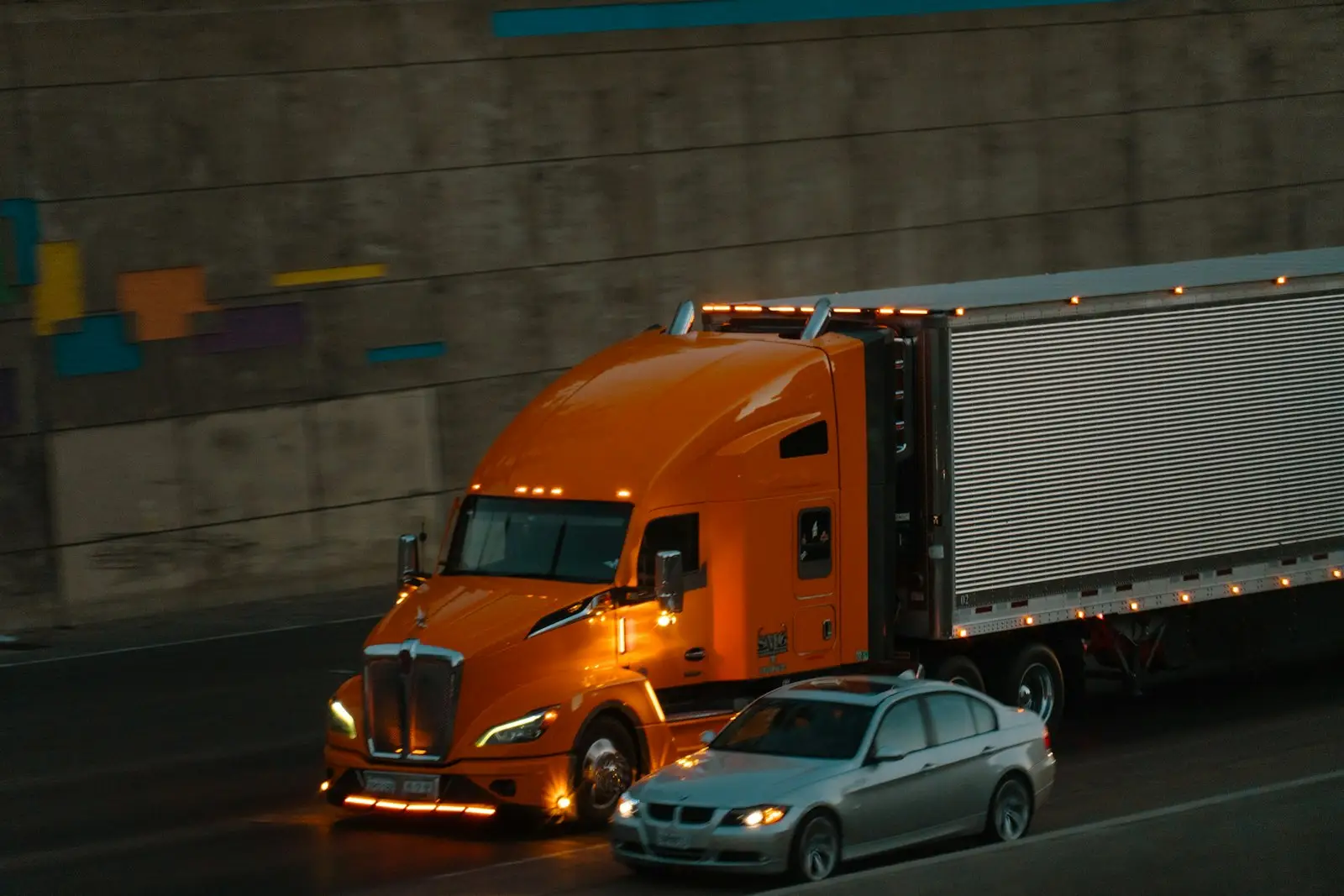
How Do Train Horns Work? Complete Explanation
How train horns produce sound — air compressor, tank, solenoid valve, diaphragm bell physics. Locomotive horns vs portable battery horns vs tank-fed truck kits.

A train horn produces sound by forcing compressed air through a metal bell with a diaphragm. The diaphragm vibrates as air rushes past it, the bell amplifies and shapes the resulting pressure wave, and the result is the characteristic deep, projecting tone you hear at a railroad crossing. The same physics applies whether you’re talking about a 38 lb cast-aluminum Nathan AirChime K5LA on a freight locomotive or a $185 portable battery-powered horn on an M18 battery — the components scale, but the principle is identical.
- Sound source
- Diaphragm vibration
- Air rushing past metal disc
- Operating PSI
- 90–150 PSI
- Locomotive + truck-kit air
- Fundamental Hz
- 300–700 Hz
- Bell-length determined
- Power source
- 12V air compressor
- Or battery on portable
- Storage
- Air tank or tankless
- Truck kit vs portable
- Trigger
- Electric solenoid
- Opens valve to release air
The five components of a train horn system
Every train horn — whether locomotive, truck-mounted, or portable — has the same five functional pieces:
- Power source — 12 V DC battery (truck), 18 V cordless tool battery (portable), or compressed air feed (locomotive).
- Air compressor — converts electrical power to compressed air. On a locomotive this is a continuously-running compressor on the prime mover; on aftermarket truck kits it’s a 1NM-class 12 V DC unit; on portable kits it’s a tiny built-in unit running directly on battery DC.
- Storage (sometimes optional) — an air tank holds reserve pressure for sustained blasts. Locomotives and full truck kits use 2–8 gallon tanks; portable units typically have no tank or a tiny reservoir.
- Solenoid valve — an electrically-actuated valve that releases compressed air to the horn when triggered. Closed by default; opens when 12 V is applied to the coil.
- The horn itself — bell or trumpet with a diaphragm that vibrates when high-pressure air flows past it. The bell length determines the fundamental frequency.
Press a button (or the OEM steering wheel horn) → the solenoid energizes → compressed air rushes from the tank or compressor through the valve → into the bell → past the diaphragm → out as sound.
How the bell makes sound
The bell is the part of the horn that actually generates the audible noise. Inside the bell housing is a metal diaphragm — a thin, lightweight disc that flexes back and forth thousands of times per second when high-pressure air passes through. The diaphragm’s resonant frequency is determined by:
- Bell length — longer bells produce lower notes (lower fundamental frequency).
- Diaphragm material and thickness — affects flex stiffness and resonance.
- Bell shape (taper) — controls how harmonics develop and how the sound projects.
The Wikipedia article on train horns notes that “the bell’s length determines the waves’ wavelength, and thus the fundamental frequency (pitch) of the note produced by the horn (measured in hertz). The longer the bell, the lower the note” (Wikipedia: Train horn).
For a chord horn like the Nathan K5LA — which plays a B major 6th of D♯, F♯, G♯, B, and high D♯ (Wikipedia: Nathan Manufacturing) — there are five separate bells of different lengths in one manifold, all sounded simultaneously. Each bell is tuned to a specific note in the chord. The fundamental notes sit between roughly 311 Hz (D♯4) and 622 Hz (D♯5), with high-order harmonics extending past 5 kHz that give the horn its distinctive cutting timbre.
Tank-fed vs tankless: the big functional difference
The single biggest variable across train horn types is whether they use an air tank or run directly on the compressor:
Tank-fed (locomotive + full truck kits)
The compressor fills a tank (typically 5–8 gallons at 110–150 PSI). When you trigger the horn, air flows from the tank to the bells — fast, high-volume, sustained. After the trigger, the compressor refills the tank for the next blast.
Result: clean tone, high SPL (147–149 dB at 3 ft on top kits), sustained 5–10 second blasts. The cost: the tank, compressor, and valve hardware fill significant install space (typically the spare tire well of a pickup) and add 50–100+ lbs.
Tankless (portable battery + small motorcycle horns)
No reservoir; the compressor runs only while the trigger is held and produces sound directly. Output stops when the compressor can’t keep up.
Result: lower peak SPL than tank-fed kits (123–142 dB on motorcycle compacts, 130–150 dB-claimed on portable battery horns), but runtime is limited by battery capacity, not blast duration — a 6 Ah pack runs the compressor through 500+ short blasts or ~200 sustained 2-second blasts before cutting out at 15% SOC. Much smaller and lighter than a tank-fed kit.
For sustained signaling, tank-fed wins. For portability, tankless wins. The HornBlasters Shocker XL is a tank-fed kit at a published 147.7 dB; the Milwaukee M18-compatible portable horns are tankless at 130–150 dB-claimed.
How a real locomotive horn works
On a Class I freight or passenger locomotive, the train horn doesn’t need a dedicated air system — it taps into the locomotive’s main reservoir air (the same pressurized air that runs the brakes). A typical North American freight locomotive’s main reservoir runs at 130–140 PSI, which is exactly the operating range of a Nathan AirChime K5LA (90–140 PSI per Locomotive Parts Supply).
Trigger flow on a real locomotive:
- Engineer pulls the horn lever on the operating console.
- Lever opens a pneumatic valve mechanically (older locomotives) or sends an electrical signal to a solenoid valve (newer locomotives).
- Main reservoir air flows through the valve, up through stainless lines, and into the K5LA’s manifold mounted on the locomotive cab roof.
- Five bells sound simultaneously, each diaphragm vibrating at its tuned frequency.
- Sound projects forward at 96–110 dB at 100 ft, the FRA-mandated range under 49 CFR 229.129, adopted alongside the Part 222 Train Horn Rule.
Because the locomotive’s compressor runs continuously and the main reservoir is huge, a real K5LA can sound for as long as the engineer holds the lever — often 30+ seconds at full grade-crossing approach. No aftermarket truck-mounted kit can replicate that sustained capability without a much larger tank than fits on a pickup.
How an aftermarket truck train horn works
Truck installs replicate the locomotive’s air system in miniature. Key components:
- 5–8 gallon air tank mounted in the spare tire well or alongside the frame rail.
- 1NM-class 12 V compressor that refills the tank. On the HornBlasters Conductor’s Special 228H, the compressor fills its 2-gallon tank from 0 to 145 PSI in about 3 minutes 5 seconds; 5–8 gallon tanks take proportionally longer.
- Pressure switch that cycles the compressor between 110 PSI (cut-in) and 145–150 PSI (cut-out).
- 1/2” Black Widow electric solenoid valve that opens when 12 V is applied to its coil.
- Trumpets or bells mounted to the truck frame, fed by 1/2” PTC air lines.
When you press the OEM horn button (typically tapped via a MICRO2 add-a-circuit on the OEM horn fuse — see /install/by-task/wiring-diagram/), the solenoid energizes and air flows from the tank to the trumpets.
The trade-off vs a locomotive is blast duration: a 5-gallon tank at 150 PSI provides about 5–7 seconds of sustained blasting before pressure drops below the horn’s operating range. After that, you wait the tank-refill time — about 55 seconds from cut-in to cut-out on the HornBlasters 228H, or 3 minutes 5 seconds for a full 0–145 PSI fill of its 2-gallon tank (a 5-gallon tank takes proportionally longer).
How a portable battery train horn works
The portable battery-powered category eliminates the tank entirely. A small onboard 12 V compressor runs directly off the battery via a step-down regulator, and air flows straight from the compressor outlet to the trumpet manifold. There’s no reservoir.
Specifically, on an M18-compatible or DeWalt 20V-compatible portable horn:
- You insert your existing 18 V battery (Milwaukee M18, DeWalt 20V MAX, Ryobi ONE+, Makita LXT, etc.).
- Pull the trigger or press the wireless remote — the onboard compressor starts.
- Compressed air immediately flows to the trumpet manifold as the compressor builds pressure.
- The horn sounds for as long as you hold the trigger, limited only by remaining battery charge — not by air pressure. The compressor runs continuously while powered.
- Release the trigger; the compressor stops and any residual pressure dumps back through a check valve.
The portable horn’s compressor is much smaller than a truck kit’s 1NM unit — typically running at 10–15 A peak vs the truck kit’s 25 A max draw — which is why portable output is mostly quoted as 130–150 dB-claimed, while top tank-fed kits publish 147–149 dB. There’s also no air reservoir, so blasts are limited to whatever the small compressor can sustain.
What changes the volume
Several factors set the SPL output of a train horn:
- Operating PSI. Higher pressure = more air flow = louder horn. The Nathan K5LA’s spec range of 90–140 PSI maps directly to its dB output: at 90 PSI it’s noticeably quieter than at 140 PSI.
- Bell or trumpet count. More bells = more total acoustic output. A 5-chime K5LA is louder than a 3-chime K3LA at the same PSI.
- Bell material and quality. Cast aluminum locomotive bells project more efficiently than stamped fiberglass-reinforced ABS truck-kit trumpets, even at identical PSI.
- Bell length and taper. Longer bells produce lower fundamentals and more efficient acoustic radiation.
- Distance from horn to listener. Inverse-square law: −6 dB per doubling of distance. A 149 dB horn at 3 ft is about 119 dB at 100 ft. See Decibels Explained.
For a runtime calculation given your specific tank and PSI, use the air tank runtime calculator.
Frequently asked questions
Why do train horns sound deeper than car horns?
Train horns use longer bells (typically 12–20 inches) than car horns (typically 3–5 inches). Longer bells produce lower fundamental frequencies (around 300–500 Hz vs 800–1500 Hz for car horns). The deep tone also comes from chord-horn voicings — a Nathan K5LA’s B major 6th chord includes the doubled D♯ at the bottom that reinforces the fundamental for long-distance projection.
Why is air-tank pressure 110–150 PSI specifically?
That’s the operating range manufacturers tune their bells for. Below 90 PSI a chord horn’s harmonic content collapses and the chord falls apart audibly. Above 150 PSI you’re not getting linearly more SPL because the diaphragm and bell geometry are tuned for that range.
Can I use a tire compressor instead of a dedicated horn compressor?
In theory yes; in practice tire compressors are sized for slow tire top-ups, not horn duty. A 1NM-class horn-grade compressor flows 1.75 CFM with a 100% duty cycle at 100 PSI and fills a 2-gallon tank from 0 to 150 PSI in roughly 2 minutes (HornBlasters 1NM spec); a typical tire compressor moves a fraction of that air, multiplying the same fill time several times over — and its limited duty cycle becomes the limiter.
Why doesn’t my portable battery horn last as long as a truck kit?
No air reservoir. A truck kit stores 5+ gallons of pre-pressurized air; a portable horn has the compressor’s instantaneous output and nothing else. Portable blast duration is limited by what the small onboard compressor can produce in real time.
Do all bells use diaphragms?
Most aftermarket train horns and locomotive horns do. Some specialty horns and air-blast sirens use different mechanisms (rotary vanes, jet acoustics) but the chord-horn category is universally diaphragm-based.
Why are some horns called “kettle drum design”?
The Nathan K-series uses a “kettle drum” double-diaphragm bell — two diaphragms in tandem rather than one. This produces a more complex harmonic content and explains the K-series’ distinctive sound. Per Wikipedia: the K in K5LA designates “kettle drum double-diaphragm.”
Sources
- Wikipedia — Train horn (chord-horn physics, bell-length frequency relationship, diaphragm operation)
- Wikipedia — Nathan Manufacturing (K5LA chord configuration, kettle drum design)
- Locomotive Parts Supply — Nathan AirChime K5LA (90–140 PSI operating range, 5-chime manifold)
- HornBlasters — How loud are your train horns (cast locomotive horns top out at 149.4 dB; dB test-distance context)
- HornBlasters — Conductor’s Special 228H product page (2-gallon tank, 0–145 PSI fill in 3:05, 110–145 PSI recovery in 55 s, 25 A max draw)
- HornBlasters — 1NM Air Compressor (1.75 CFM flow, 100% duty cycle at 100 PSI, ~2-min 2-gallon fill)
- eCFR — 49 CFR 229.129 Locomotive horn (96 dB(A) minimum / 110 dB(A) maximum at 100 ft forward of the lead locomotive)
- Federal Railroad Administration — Train Horn Rule (Train Horn Rule and quiet-zone context)
- SoundTraxx — Locomotive Airhorn History (industry context for chord-horn evolution)
We do not perform hands-on testing — see our methodology for how we evaluate manufacturer claims.
Frequently asked questions
Quick answers to the questions people ask most about this topic.
- How does a train horn actually make sound?
- A train horn forces compressed air through a metal bell containing a diaphragm. The diaphragm vibrates as air rushes past it, and the bell amplifies and shapes the resulting pressure wave into the deep, projecting tone you hear.
- What are the main parts of a train horn system?
- Every train horn system has the same five functional pieces: a power source, an air compressor, storage such as an air tank, a solenoid valve that releases the air when triggered, and the horn bell or trumpet itself.
- What determines the pitch of a train horn?
- The bell length determines the fundamental frequency, with longer bells producing lower notes. Diaphragm material and thickness and the bell taper also affect the resonance and how harmonics develop.
- Why doesn't my portable battery horn last as long as a truck kit?
- A portable battery horn has no air reservoir, so it runs only on the small onboard compressor's instantaneous output. A truck kit stores 5 or more gallons of pre-pressurized air, so its blast duration is limited by air pressure rather than real-time compressor output.
- Can I use a tire compressor instead of a dedicated horn compressor?
- In theory yes, but in practice tire compressors are sized for slow tire top-ups, not horn duty. A horn-grade unit like the HornBlasters 1NM flows 1.75 CFM with a 100 percent duty cycle at 100 PSI and fills a 2-gallon tank in about 2 minutes; a typical tire compressor moves a fraction of that air, stretching refill time dramatically.
- Why are train horns deeper than car horns?
- Train horns use longer bells, typically 12 to 20 inches, compared with 3 to 5 inches on car horns, which produces lower fundamental frequencies of around 300 to 500 Hz versus 800 to 1500 Hz for car horns. Chord-horn voicings with a doubled low note also reinforce the deep tone for long-distance projection.
Related reviews & guides
Wayside Horns Explained: Pole-Mounted Crossing Horns and FRA Rules
Train Horn Safety Relief Valve: PSI Rating, Placement and Testing

Locomotive Horn Rules: What 49 CFR 229.129 Requires (96-110 dB)
Train Horn Kit Weight: Tank, Compressor & Payload Math Explained

Train Horn Dual Battery Setup: Isolators, Relays & Voltage