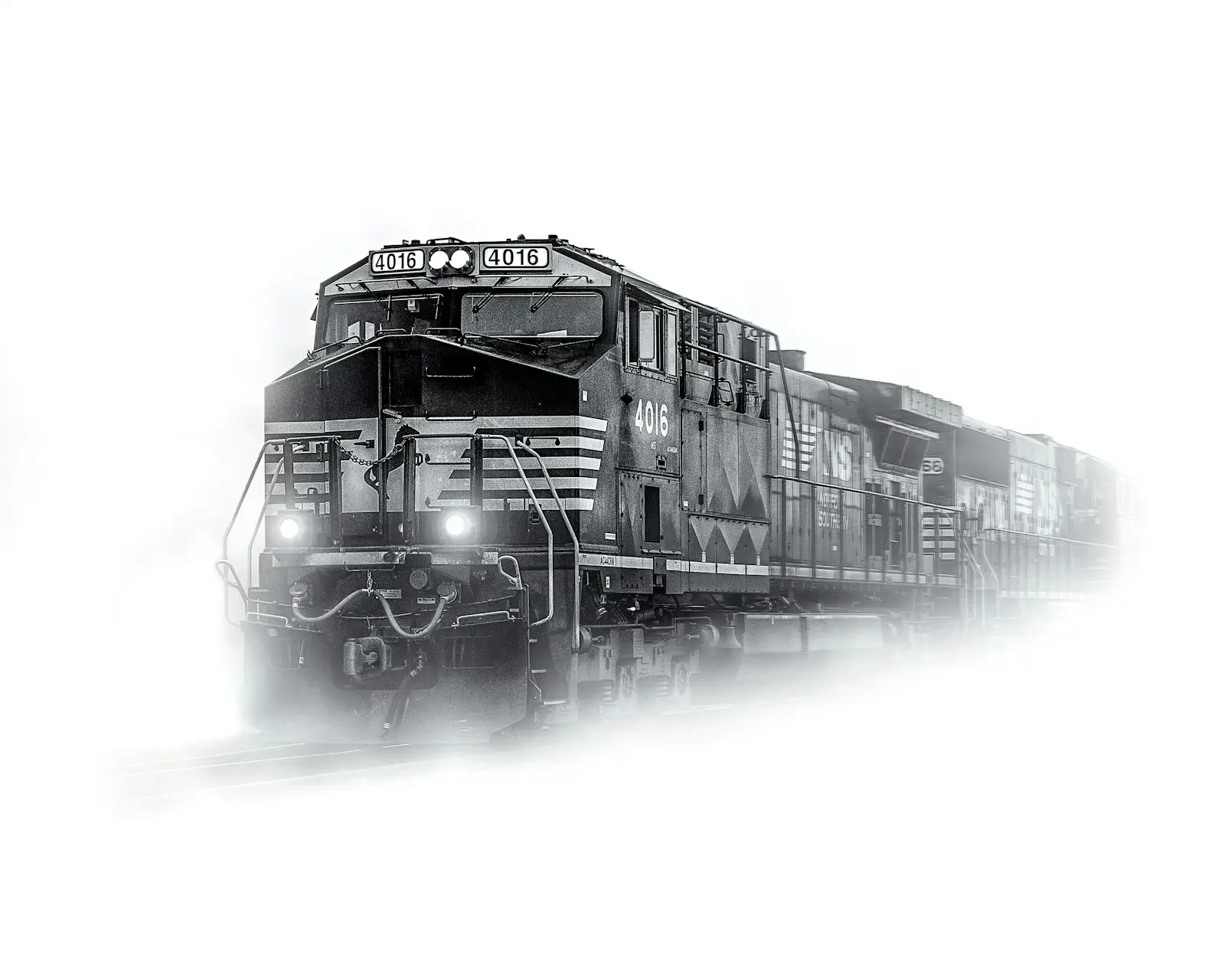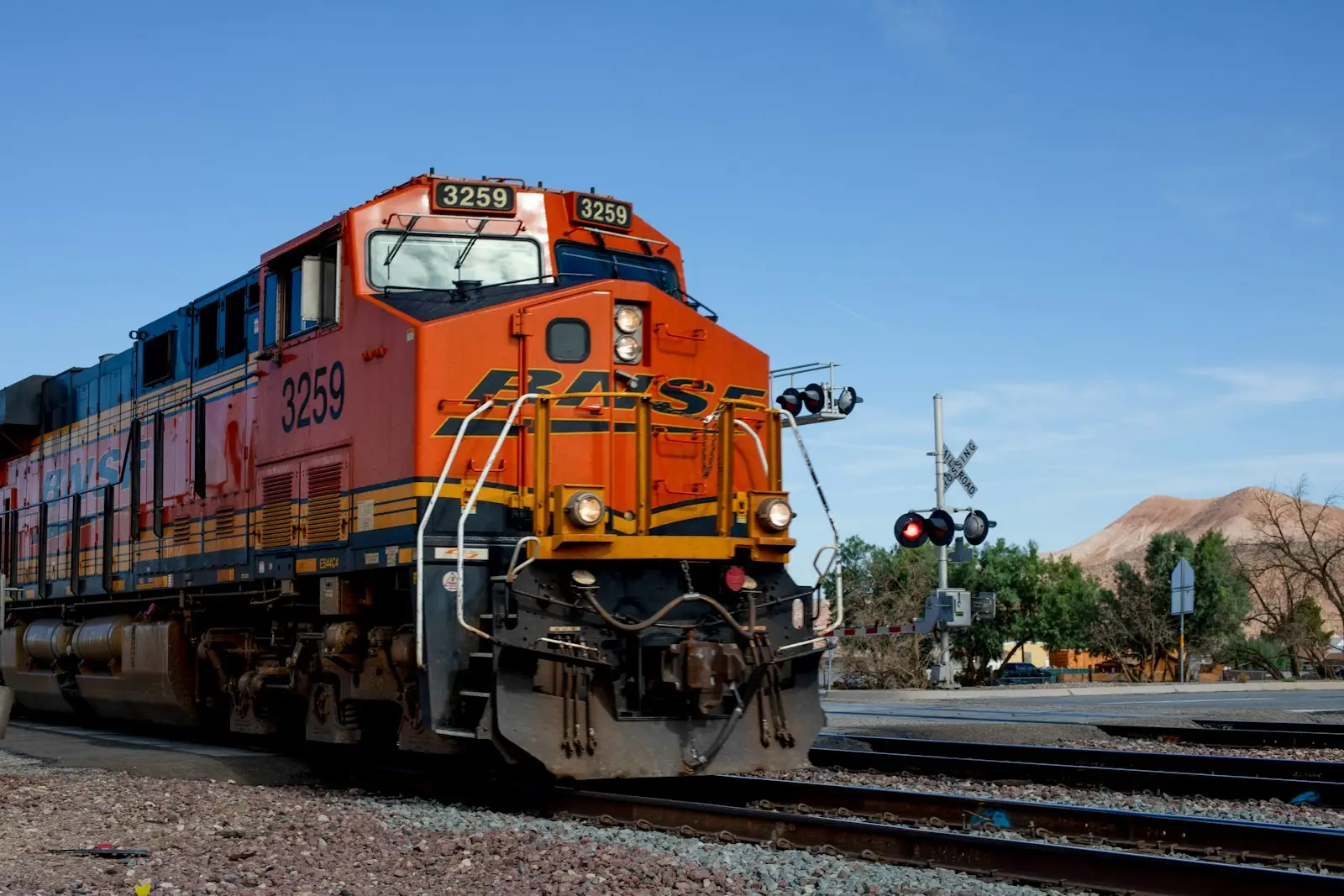
- +The signature "freight train" sound of North America — Nathan AirChime supplies 90%+ of U.S. locomotive horns
- +Documented B major 6th chord (D♯/F♯/G♯/B/D♯) used on Amtrak, CSX, and most Class I freight
- +Operating range 90–140 PSI — tolerant of imperfect aftermarket air systems
- +Cast aluminum bell construction with replaceable bells (#1, #2, #3A, #4A, #5)
- +5-year horn warranty when sold via HornBlasters' kit packaging
- −Standalone horn ~$1,700 USD; complete aftermarket kit $5,000+ — premium price tier
- −38 lb horn requires substantial structural mounting (frame, dedicated bracket)
- −Needs a real air system: 5-gallon tank minimum and 1NM-class compressor for 5–7 second blasts
- −Aftermarket buying channels are narrow — HornBlasters, Locomotive Parts Supply, a few specialists
- −144 dB at 10 ft is well above the statutory horn limit in most states (typically 110–118 dB FMVSS 141 ceiling)
Methodology
This review aggregates publicly available information from Nathan AirChime’s manufacturer site, two specialty aftermarket retailers (HornBlasters and Locomotive Parts Supply), and Wikipedia’s catalog of Nathan Manufacturing horn models. We do not perform hands-on testing of locomotive air horns. All numeric claims are cited inline. Last reviewed: September 2, 2026.
Quick verdict
The Nathan AirChime K5LA is, in editorial opinion, the default reference for what a North American train sounds like. If you’ve heard a freight train approach a grade crossing in the U.S. since the late 1980s, you’ve almost certainly heard a K5LA. As an aftermarket purchase it is also expensive, heavy, and demanding of its air system — a serious commitment, not a casual upgrade. We rate it 4.7/5 for buyers who specifically want the K5LA chord and have the platform to mount it correctly.
What the K5LA actually is
The K5LA is a 5-chime cast-aluminum locomotive air horn manufactured by Nathan AirChime, now a brand of Nautilus Integrated Solutions (Nathan AirChime, official). The model designation breaks down as:
- K — kettle-drum double-diaphragm bell design
- 5 — five chimes (five tuned bells in one manifold)
- L — low-profile manifold (the lower-profile bracket AirChime introduced alongside the new chord in 1975)
- A — American tuning (vs Canadian)
The horn was developed in 1975 at the suggestion of Amtrak’s Deane Ellsworth as a replacement for the Leslie SL-4T, entered production in the late 1970s, and by the late 1980s had become North America’s most popular locomotive horn (Wikipedia: Nathan Manufacturing; Locomotive Wiki: K5LA). It is the standard horn on CSX locomotives, was the voice of Amtrak’s F40PH passenger fleet, and remains the most-used 5-chime in North America.
The chord
The K5LA plays a B major 6th chord built from the bells listed in its manifold spec (Wikipedia: Nathan Manufacturing):
| Bell | Note | Approx. frequency |
|---|---|---|
| #1 | D♯4 | 311.13 Hz |
| #2 | F♯4 | 369.99 Hz |
| #3A | G♯4 | 415.30 Hz |
| #4A | B4 | 493.88 Hz |
| #5 | D♯5 (octave) | 622.25 Hz |
The doubled D♯ at the bottom and top reinforces the fundamental for long-distance projection; the major-6 voicing gives it warmth that distinguishes it from harder-edged variants like the K5HL-R2 (C minor 7♭5) or the K5LLA-R1 (G♯7♯9). You can hear an approximation on our interactive soundboard, and find a real recording in the K5LA sound library entry.
Specifications
All figures from manufacturer and aftermarket retailer listings (Locomotive Parts Supply; HornBlasters Kit):
| Spec | Value | Source |
|---|---|---|
| Configuration | 5-chime, low-profile manifold | Nathan AirChime |
| Bells | #1, #2, #3A, #4A, #5 | Locomotive Parts Supply |
| Chord | B major 6th | Wikipedia |
| Material | Cast aluminum | Locomotive Parts Supply |
| Weight | ≈ 38 lb (horn only) | Locomotive Parts Supply |
| Dimensions | 16.5″ L × 29.75″ W × 10″ H | Locomotive Parts Supply |
| Air inlet | 1/2″ NPT | Locomotive Parts Supply |
| Operating pressure | 90 – 140 PSI | Locomotive Parts Supply |
| Sound output | 144 dB @ 10 ft (retailer claim; not shown on the current LPS listing as of Sept 2026) | Locomotive Parts Supply (prior listing) |
| Third-party measurement (K5 platform) | 149.4 dB at close range | HornBlasters (third-party test; lab not named) |
| Standalone horn price | $1,699.95 USD (periodically sold out) | Locomotive Parts Supply |
| Complete kit price | $4,999 (HD-544K) – $5,199 (XD-844K) | HornBlasters |
| Horn warranty (HornBlasters kit) | 5 years | HornBlasters |
What you get in a complete aftermarket kit
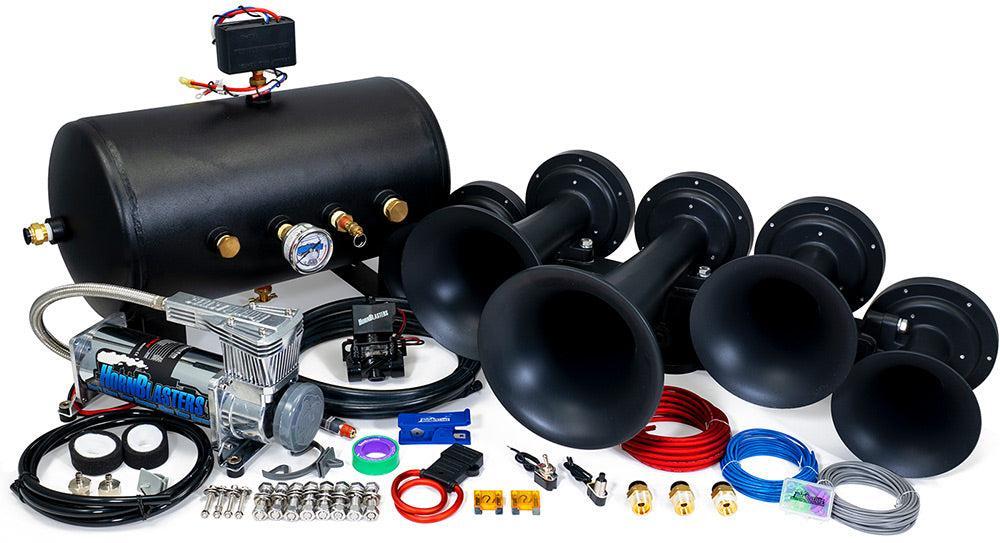
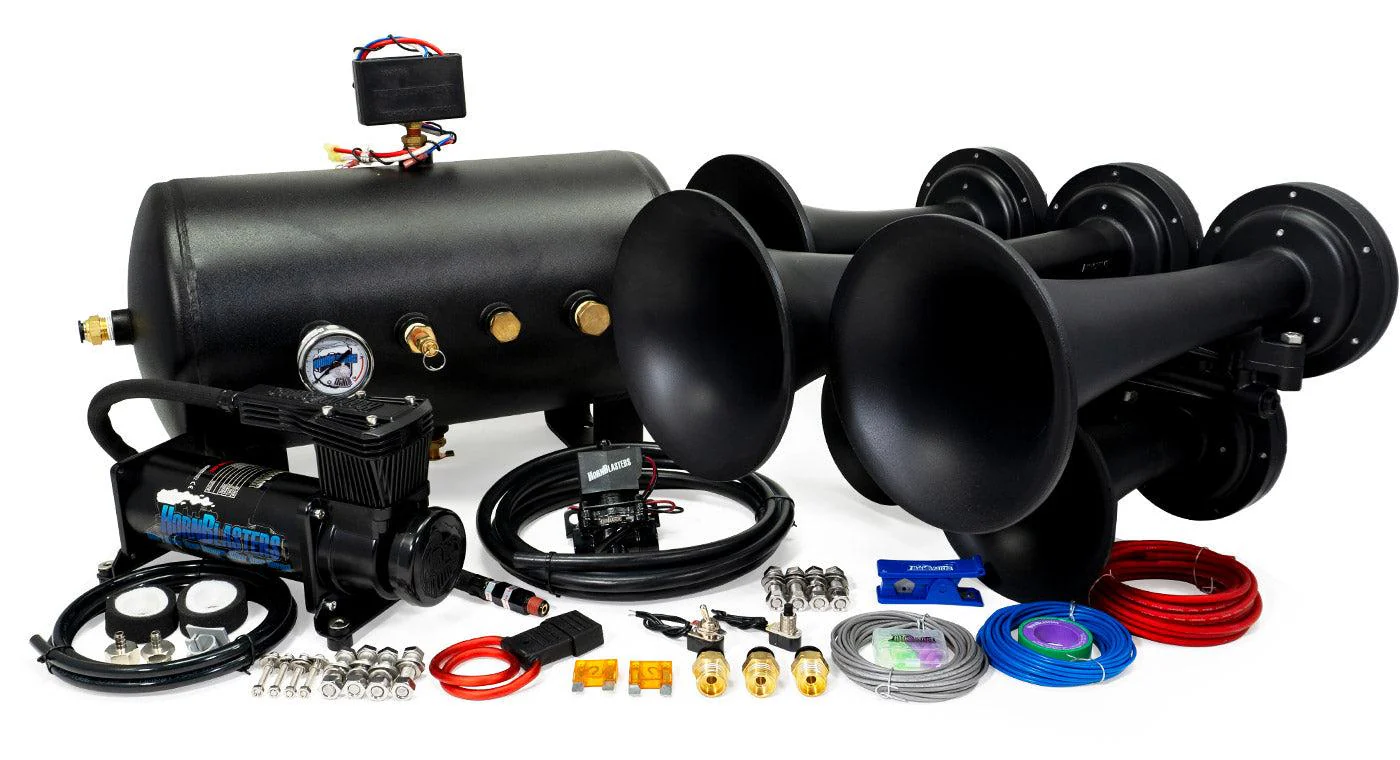
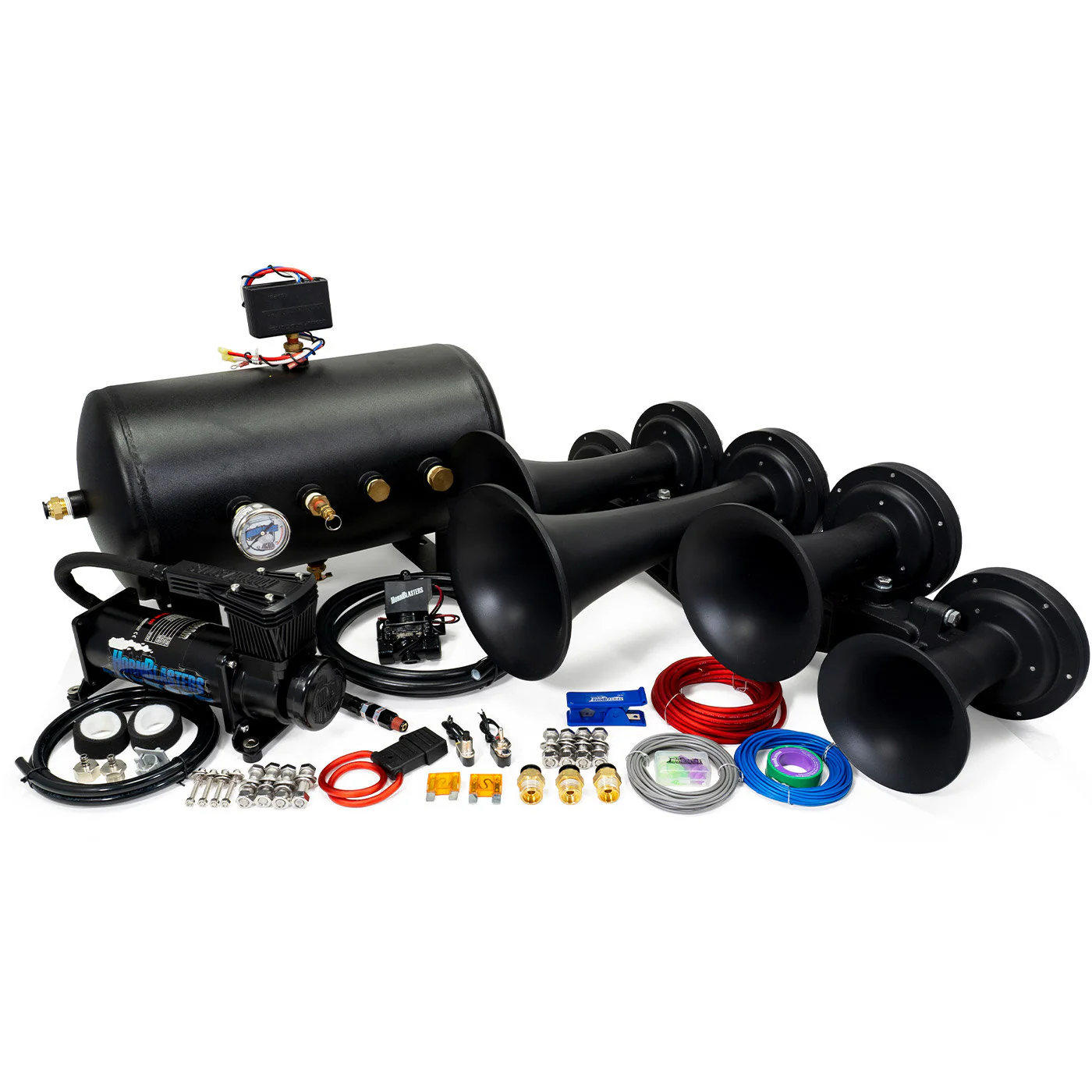
The K5LA itself doesn’t make sound without an air system. HornBlasters packages it with everything needed for a 12 V DC vehicle install (HornBlasters K5LA kit):
- Horn: Nathan AirChime K5LA, cast aluminum, 37 lb (HornBlasters spec; LPS lists ~38 lb)
- Tank: 5-gallon, 8-port (HD-544K) or 8-gallon, 8-port (XD-844K)
- Compressor: 1× 1NM (HD) or 2× 1NM (XD), 110 / 150 PSI cut-in/out
- Valve: 1/2” Black Widow electric solenoid
- Wiring: Complete kit including gauge wire, fuse holder, relays
- Honk duration: 5–7 seconds (HD) or 8–10 seconds (XD) per refill cycle
- Tank fill time: 6 min 45 s for 0–150 PSI on the 544K
- Duty cycle: 33 % at 100 PSI (HD) / 100 % at 100 PSI (XD)
- Power: 12 V DC, 26 A peak (HD) / 50 A peak (XD)
- Warranty: 5-year horn / 2-year balance-of-kit
Pros and cons
Pros:
- It is the locomotive horn 90% of Americans have already heard. Nothing else gets you the same instant sonic recognition.
- Documented B major 6th chord with the doubled D♯ has unusual sonic texture for a transportation signal — warm and assertive at the same time.
- Wide 90–140 PSI operating range means it works on a range of aftermarket tank pressures without retuning.
- Rebuildable: bells #1, #2, #3A, #4A, #5 can be sourced individually from Nathan AirChime resellers if a single bell is damaged.
- 5-year horn warranty (in HornBlasters kit packaging) is the longest in the aftermarket category.
Cons:
- Premium price tier. The horn alone is ~$1,700; a complete kit clears $5,000.
- Heavy. 38 lb means you need a frame mount and bracketing, not a bumper bracket.
- Air-system demanding. A 5-gallon tank and at least one 1NM-class compressor are the minimum for usable blast duration.
- Narrow buying channels in the aftermarket — Nathan does not sell direct to consumers, so you’re going through HornBlasters, Locomotive Parts Supply, or a small handful of specialists.
- 144 dB at 10 ft far exceeds the statutory replacement-horn ceiling under FMVSS 141 (118 dB at 2 m forward) and most state vehicle codes (typically 110 dB). It is essentially off-road or property use only if you want to stay legal — see our legal hub for state-by-state caps.
Alternatives
Three credible alternatives to compare against the K5LA:
- HornBlasters Shocker XL — 154 dB four-trumpet flagship at roughly 1/3 the K5LA kit price. Trumpet-shape rather than locomotive-bell construction; sound profile is brighter and harsher. The right pick if you want maximum dB-per-dollar.
- Leslie RS3L Supertyfon — the historic 3-chime alternative, once the most common horn on North American railroads before the K5LA took over (per Wikipedia). Smaller package, simpler chord, lower price. The right pick if you want 1960s–80s freight sound.
- Nathan K3LA — the 3-chime cousin in the same K series. Smaller, lighter, less expensive, less authoritative chord. The right pick if your air system can’t support a 5-chime or you want a smaller-package locomotive sound. Common on Metra cab cars and EMUs.
For portable / no-air-tank options, see the Milwaukee M18, DeWalt 20V MAX, Ryobi ONE+, and Makita LXT battery-powered horn pages.
How to buy
Nathan AirChime sells B2B only through its parent Nautilus Integrated Solutions — direct retail purchase is not offered. Aftermarket channels:
- HornBlasters — complete kit packaging with HornBlasters compressor, tank, valve, and wiring. $4,999.99 (HD-544K) and up. Five-year horn warranty. The same kit can be ordered with the K5HA high-mount horn instead of the K5LA at identical pricing.
- Locomotive Parts Supply — standalone horn with bead-blasted finish, new internals. $1,699.95 (frequently sold out — these are rebuilt-to-order, so expect a wait if inventory is zero).
- Pure Diesel Power, Triplex Motorsports — secondary channels, generally re-selling HornBlasters or LPS stock. (Air Horns of Texas, formerly a third option, was offline as of September 2026.)
Verify with each retailer that the unit ships with the standard K5LA bell set (#1, #2, #3A, #4A, #5); some used or refurbished listings substitute bells from K5H or K5HL-R2 manifolds, which produce a noticeably different chord.
Frequently asked questions
What does the K5LA sound like?
A B major 6th chord spanning two octaves: D♯, F♯, G♯, B, D♯. It is the iconic “freight train” sound most U.S. listeners associate with a passing locomotive. Hear an approximation on our interactive soundboard.
Why does the K5LA cost so much more than a truck horn?
Because it’s a real locomotive horn — Nathan AirChime supplies 90 %+ of U.S. locomotive air horns to Class I and Class II railroads, and the K5LA is built to the same spec as those OEM units. Cast aluminum construction, replaceable bells, and the kettle-drum diaphragm design are all expensive to manufacture compared to stamped-trumpet truck horns.
How loud is 144 dB at 10 ft really?
By the inverse-square law (≈ −6 dB per doubling of distance), 144 dB at 10 ft is roughly 132 dB at 40 ft, 120 dB at 160 ft, and 108 dB at 640 ft. Those are still well above the OSHA 8-hour permissible exposure limit (90 dBA) — meaning anyone within a few hundred feet of an unmuffled K5LA blast is being exposed to potentially hazardous SPL. See our decibel-distance calculator for a specific reading.
Is the K5LA legal to install on a road vehicle?
In most U.S. states, no — not for normal road use. State vehicle codes typically cap horn output around 110 dB measured at the source or front of vehicle, and federal FMVSS 141 caps replacement passenger-vehicle horns at 118 dB at 2 m forward. A 144 dB K5LA exceeds both by a wide margin. It can be installed for off-road, agricultural, marine, or stationary use, but on-road use exposes you to citations and noise-ordinance fines. See our legal hub and state legality lookup.
What’s the difference between the K5LA, K5HL, and K5LLA?
All three are Nathan 5-chime horns built on the K-series kettle-drum platform. They differ in chord and bell layout:
- K5LA — B major 6th (D♯/F♯/G♯/B/D♯). The default freight horn.
- K5HL-R2 — C minor 7♭5 (C/D♯/F♯/A♯/C). Darker, half-diminished voicing.
- K5LLA-R1 — G♯7♯9 (C/D♯/F♯/G♯/B). Dominant 7♯9 (“Hendrix chord”), tense.
Per Wikipedia, the K5LLA and K5HL have since surpassed the K5LA in new installations, though the K5LA remains one of the most-used 5-chime horns in the world.
Can I run a K5LA on a small portable air tank?
Technically yes for a single short blast, but not usefully. The K5LA’s 5-bell manifold needs roughly 14–16 SCFM at 100 PSI to sustain a clean tone. A 5-gallon tank at 150 PSI cut-out gives you ~5–7 seconds before the compressor can’t keep up; below 90 PSI the chord starts to fall apart. Anything smaller than a 5-gallon tank is essentially a one-blast novelty.
Does Nathan sell the K5LA directly to consumers?
No. Nathan AirChime / Nautilus Integrated Solutions operates B2B through quote requests, primarily to railroads and OEMs. Consumers buy through aftermarket specialty retailers — HornBlasters, Locomotive Parts Supply, etc. — that resell or repackage the OEM horn with a complete air system.
What changed between the original 1970s K5LA and the current production?
The exterior dimensions, bell count, and chord are unchanged. Internal hardware revisions over the decades have improved diaphragm longevity and corrosion resistance, and the standard finish has shifted between bare aluminum, bead-blasted, and powder-coated variants depending on the production run. Aftermarket K5LAs from Locomotive Parts Supply ship with “new hardware & internals” and a bead-blasted exterior finish.
Sources
- Nathan AirChime — manufacturer site (90 %+ of U.S. locomotive horns; B2B-only model)
- Wikipedia — Nathan Manufacturing (K5LA chord = B major 6th, 1975 Deane Ellsworth history, model-by-model chord catalog)
- Wikipedia — Train horn (chord-horn physics, Nathan/Leslie market share)
- Locomotive Parts Supply — Nathan AirChime K5LA Locomotive Train Horn (standalone horn $1,699.95, dimensions, 90–140 PSI, bell layout; 144 dB @ 10 ft figure from a prior version of the listing)
- HornBlasters — Nathan AirChime K5 Train Horn Kit (complete kit pricing, tank/compressor specs, fill time, duty cycle, warranty)
- HornBlasters — The World’s Loudest Train Horns (K5LA 149.4 dB third-party test result)
- Locomotive Wiki — Nathan K5LA Airhorn (history: late-1970s production, Chessie/CSX first user, Amtrak replacement for the Leslie SL-4T)
- SoundTraxx — Locomotive Airhorn History (industry context for Nathan K-series adoption)
Train Horn aggregates publicly available data. We do not test products in-house. All trademarks belong to their respective owners. Pricing and availability verified September 2, 2026; check current retailer listings before purchase.
The K5LA is the locomotive horn most North Americans recognize as 'a train.' If you're building a no-compromise on-vehicle replica, it's the reference — but the price, weight, and air-system requirements push it firmly into hobbyist-or-bust territory.
Frequently asked questions
Quick answers to the questions people ask most about this topic.
- What does the Nathan K5LA sound like?
- It plays a B major 6th chord spanning two octaves using the notes D-sharp, F-sharp, G-sharp, B, and D-sharp. It is the iconic freight-train sound most U.S. listeners associate with a passing locomotive.
- How loud is 144 dB at 10 ft really?
- By the inverse-square law, 144 dB at 10 ft is roughly 132 dB at 40 ft, 120 dB at 160 ft, and 108 dB at 640 ft. Those levels are still well above the OSHA 8-hour permissible exposure limit of 90 dBA, so anyone within a few hundred feet of an unmuffled blast is exposed to potentially hazardous sound levels.
- Is the K5LA legal to install on a road vehicle?
- In most U.S. states no, not for normal road use. State vehicle codes typically cap horn output around 110 dB and federal FMVSS 141 caps replacement passenger-vehicle horns at 118 dB at 2 m forward, and a 144 dB K5LA exceeds both by a wide margin. It can be installed for off-road, agricultural, marine, or stationary use.
- Can I run a K5LA on a small portable air tank?
- Technically yes for a single short blast, but not usefully. The 5-bell manifold needs roughly 14 to 16 SCFM at 100 PSI to sustain a clean tone, and a 5-gallon tank at 150 PSI cut-out gives only about 5 to 7 seconds before the compressor can't keep up. Anything smaller than a 5-gallon tank is essentially a one-blast novelty.
- Does Nathan sell the K5LA directly to consumers?
- No. Nathan AirChime, part of Nautilus Integrated Solutions, operates B2B through quote requests primarily to railroads and OEMs. Consumers buy through aftermarket specialty retailers such as HornBlasters and Locomotive Parts Supply that resell or repackage the OEM horn with an air system.
- How much does a complete K5LA kit cost?
- The horn alone is about $1,700 (Locomotive Parts Supply lists it at $1,699.95, periodically sold out), while a complete aftermarket kit runs from $4,999 for the HD-544K to $5,199 for the XD-844K through HornBlasters, which includes the tank, compressor, valve, and wiring with a 5-year horn warranty.