Short answer
Train horns are legal to own and install in California, but the way you equip and use one can cross the line fast. CVC §27000 requires that no horn “emit an unreasonably loud or harsh sound,” and CVC §27001 says a driver may sound the horn only “when reasonably necessary to insure safe operation.” California has no numeric decibel cap for vehicle horns — a 2010 bill (AB-2245) that would have capped aftermarket horns at 110 dB(A) was vetoed by the Governor, who noted that existing law already bars “unreasonably loud or harsh” horns.
A typical 150 dB train horn plainly fits the “unreasonably loud or harsh” description. In practice, enforcement comes down to whether a CHP officer judges the horn that way — and they almost always will. That’s why we label California restricted, not “legal.”
Updated 2026-06-20: corrected the statute attribution (the loudness rule is §27000, not §27001) and removed an outdated claim of a 110 dB statutory cap — that cap (AB-2245) was vetoed in 2010 and never became law.
What the statute actually says
California’s horn law is split across four short sections of the Vehicle Code:
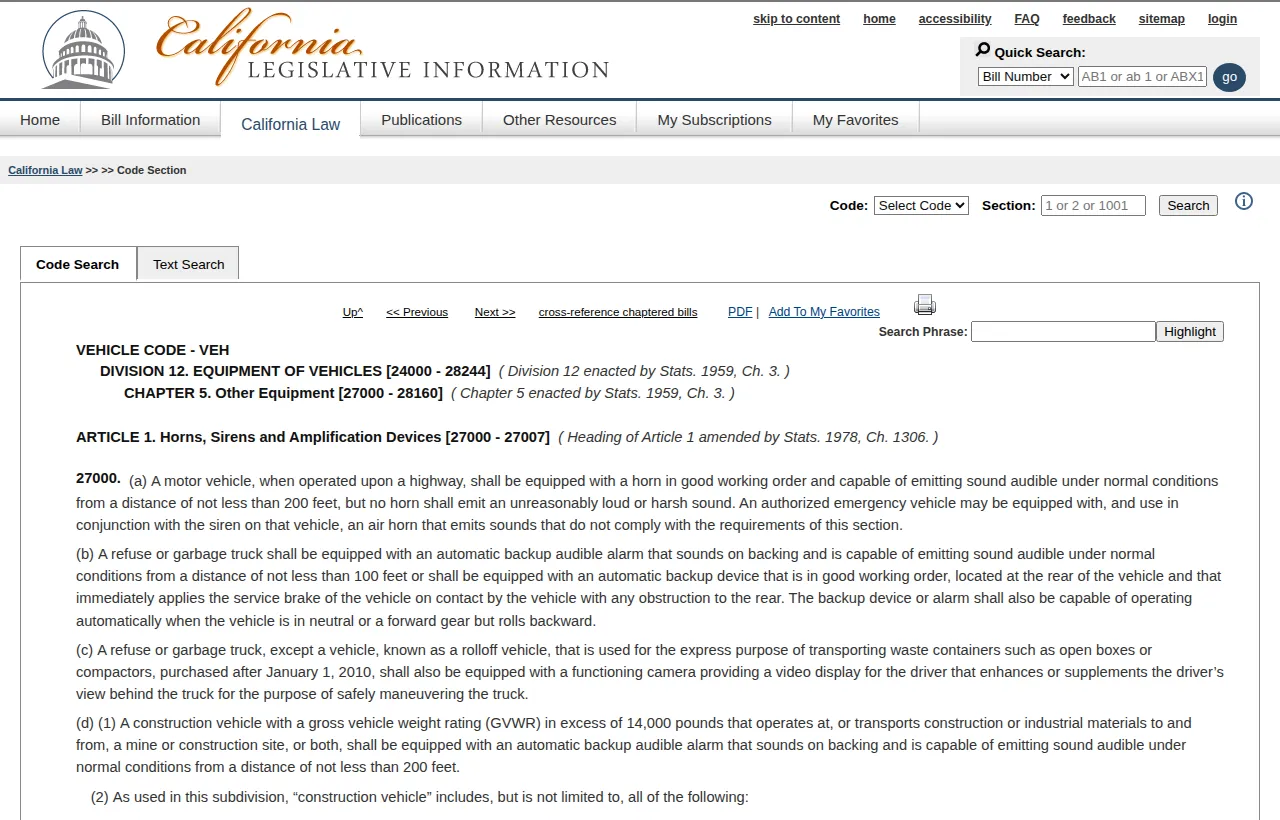
- §27000 is the equipment rule and the catch-all. Every motor vehicle must have a working horn audible from at least 200 feet, but “no horn shall emit an unreasonably loud or harsh sound.” A loud train horn fitted to the vehicle is judged against this clause.
- §27001 governs when you may use the horn: a driver “when reasonably necessary to insure safe operation shall give audible warning with his horn,” and the horn “shall not otherwise be used” except as an approved theft-alarm system.
- §27002 bans any siren (and limits Hi-Lo evacuation tones) except on authorized emergency vehicles.
- §27003 is a narrow provision letting an armored car carry a siren for use while resisting armed robbery — it does not make the car an emergency vehicle and is not a general horn rule.
Most train horn citations in California are written under §27000 (an “unreasonably loud or harsh” horn fitted to the vehicle) or §27001 (using the horn when it isn’t necessary for safe operation). §27002 (siren ban) has occasionally been used against electric air-horn kits that cycle tones.
The decibel limits you’ll hear cited
Here’s the part most online guides get wrong: California does not put a number on it. There is no numeric decibel cap for vehicle horns anywhere in the Vehicle Code.
- The 2010 legislature did try. AB-2245 would have made it unlawful to equip a vehicle with an aftermarket horn louder than 110 dB(A). Governor Schwarzenegger vetoed it on September 23, 2010, writing that “current law already prohibits a motor vehicle’s horn from emitting an unreasonably loud or harsh sound.” So the bill — and its 110 dB number — never became law. (Updated 2026-06-20: earlier versions of this page repeated the 110 dB figure as if it were a statutory limit; it is not.)
- There is also no federal cap on how loud a horn may be. Federal horn rules focus on a minimum audibility, not a maximum loudness. (FMVSS 141, sometimes cited here, is the EV/hybrid “quiet car” minimum-sound rule for pedestrians — it has nothing to do with capping horn output.)
Because there’s no number, the standard is qualitative: §27000’s “unreasonably loud or harsh sound.” That gives officers a basis for citation whenever they judge the horn to cross the line — and a 150+ dB train horn obviously does.
What happens at a traffic stop
California is a “fix-it ticket” state for most equipment violations. If an officer writes you up under §27000 for the horn itself:
- First offense: typically a correctable violation. You get ~30 days to remove the horn or replace it with a compliant one, then provide proof to the court. Fine waived on compliance.
- Repeat / uncorrected: fine of $25–$197 plus state and county assessments (realistic total $150–$400).
- §27001 misuse (sounding the horn when it isn’t reasonably necessary for safe operation): treated as an improper-use violation rather than an equipment fix-it.
No train horn cases we’re aware of have gone to a full noise-meter test at roadside — and since there’s no statutory dB number to test against, there’s little reason to. Citations are written on the officer’s judgment under §27000’s “unreasonably loud or harsh” clause, which courts have consistently upheld.
What’s actually enforced in practice
Anecdotally, California CHP enforcement varies dramatically by region:
- Urban coastal counties (LA, SF, San Diego, Orange): active enforcement. Train horns installed on lifted trucks are visible, and officers write tickets.
- Central Valley (Fresno, Bakersfield, Modesto): looser. Aftermarket horns on pickups are common and rarely cited unless used in traffic.
- Rural northern counties (Siskiyou, Trinity, Humboldt): minimal enforcement outside of misuse complaints.
None of this is a license to ignore the law. If another driver complains or dashcam footage surfaces online, a citation can follow days later.
Practical guidance
If you’re determined to install a train horn in California:
- Keep it physically disabled on public roads. Use a dedicated switch with a locking cover, and only arm the horn on private property or closed courses. This is what most California builders actually do.
- Don’t use it in traffic. §27001 (improper-use) enforcement is much more aggressive than §27000 installation enforcement.
- Consider a lower-dB portable alternative. Battery-powered horns in the 125–140 dB range are far less likely to trigger a citation. See our by-platform coverage.
- Don’t modify your registered emergency vehicle horn. Sirens are a separate category under §27002 and the penalties step up significantly.
Common misunderstandings
- “It’s only illegal to use, not to own.” Partially true. §27000 speaks to the horn fitted on the vehicle, not just its use. An installed horn can be the basis of a §27000 citation if an officer judges it “unreasonably loud or harsh,” even without a sounding event.
- “150 dB is legal because no law puts a number on it.” It’s true that neither California nor federal law sets a numeric dB cap for horns (the 110 dB AB-2245 bill was vetoed). But §27000’s qualitative “unreasonably loud or harsh” rule still applies — and a 150 dB train horn squarely fits it.
- “My horn came with a DOT stamp.” DOT stamps appear on many imported horns. They’re not an enforcement shield in California — CHP cites under state law, not federal.
How to verify current law
California codes change. Before you install, confirm with primary sources:
- Read the Vehicle Code sections linked above in our Sources section
- Check the CHP Commercial Vehicle Enforcement Section bulletins for the current year
- For commercial vehicles, reference the CA MCSR (motor carrier safety regulations)
If in doubt, email our editorial desk with the statute question and we’ll cite a source.
Nearby states & related laws
All 50 states →Texas
Texas train horn law (Tex. Transp. Code §547.501): vehicle horn rules, Houston / Dallas / Austin enforcement, aftermarket horn regulations. Plain-English guide.
Florida
Florida Statute §316.271 covers vehicle horns. Install is not prohibited; unreasonably loud use is a nonmoving traffic infraction. Plain summary.
Continue on Train Horn
All 50 states
Full state-by-state legality index with statuses, citations, and decibel caps where defined.
Decibel distance calculator
Inverse-square-law tool that shows perceived loudness at any distance from the horn.
Battery-powered platforms
Horns organized by cordless-tool battery — Milwaukee M18, DeWalt 20V, Ryobi, Makita.
HornBlasters Shocker XL review
154 dB four-trumpet flagship kit — measured output, install notes, and verdict.
Sources & Citations
- [1] California Vehicle Code §27000 — Horn Equipment (audible 200 ft; no unreasonably loud or harsh sound)
- [2] California Vehicle Code §27001 — When the Horn May Be Used
- [3] California Vehicle Code §27002 — Sirens Prohibited (except authorized emergency vehicles)
- [4] California Vehicle Code §27003 — Armored Car Sirens
- [5] California AB-2245 (2009–2010) — proposed 110 dB(A) aftermarket-horn cap, vetoed Sept 2010
Educational content. Not legal advice. Verify current statutes with your state DMV or a licensed attorney before installation.