Train Horn on a Tesla Cybertruck: 48V, Inverter Kit & Mounting
How to install a train horn on a Tesla Cybertruck: why the 48V system kills 12V kits, the 110V-to-12V outlet kit, 400W feed math, and where to mount on stainless.
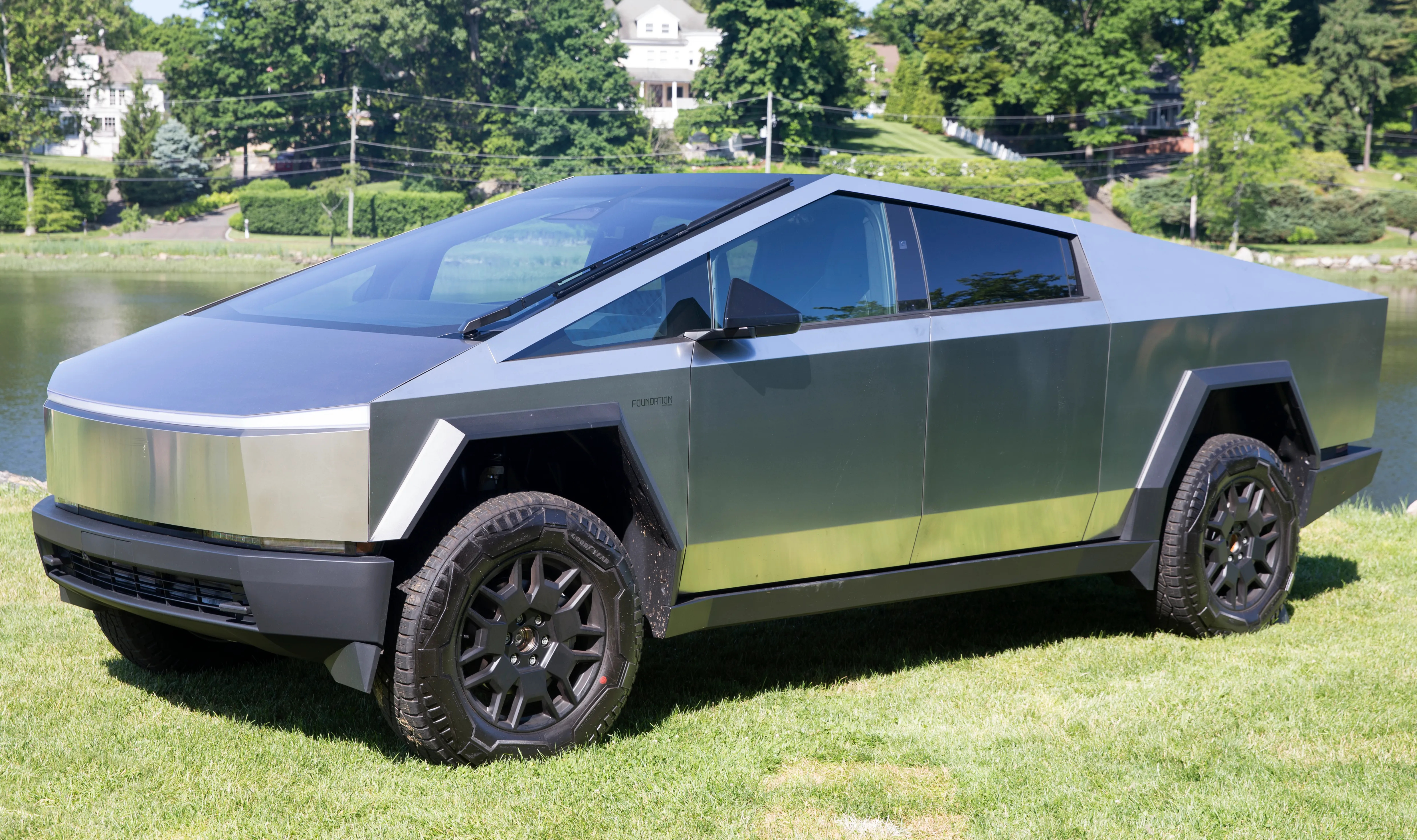
Putting a train horn on a Tesla Cybertruck is a different job than any other truck, because there is no 12-volt system to wire into: the low-voltage side runs at 48 volts. The fix is the truck’s own 120-volt outlets, and HornBlasters sells a $99.99 Cybertruck install kit built on exactly that idea.
Why the Cybertruck Breaks the Normal Train Horn Playbook
Nearly every train horn kit sold in the US is a 12-volt DC product. The compressor, pressure switch, and solenoid valve all expect roughly 12 to 14 volts, which is the setup our general Tesla and EV train horn install guide covers for the Model 3 and Model Y.
The Cybertruck is the exception. Per Tesla’s own accessory documentation, its low-voltage system is nominally 44 to 50 volts, with an allowable range of 28 to 58 volts. Battery Design’s teardown notes put real-world operating voltage at about 41 to 42 volts, from a lithium-ion auxiliary battery that weighs only 4.8 pounds. That voltage runs the steering actuators, drive-unit oil pumps, window motors, and wipers.
Three things follow from that:
- Nothing in a 12 V horn kit can touch the truck’s 48 V wiring directly. A 12 V compressor fed 44 volts is a dead compressor.
- Tesla explicitly warns that the two factory 48 V power feeds are the only approved tap points, and that splicing anywhere else “can lead to unpredictable or unexpected results (such as a total loss of power steering)”. Damage from unapproved taps is not covered by the warranty.
- Each of those two feeds is capped at 400 watts. That number matters, and we’ll do the math below.
Option 1: The 120V Outlet Route (the “110V Inverter Kit”)
This is the path HornBlasters used for its documented 2024 Cybertruck build, and it is the one we recommend. AWD and Cyberbeast trucks carry five AC outlets: two 120 V in the cabin and two 120 V plus one 240 V in the bed, fed by the truck’s Powershare inverter at up to 9.6 kW.
The Tesla Cyber Truck Train Horn Install Kit (part number WK-CT) is listed at $99.99 on sale, $119.99 regular. It contains a 110 V-to-12 V converter rated for 50 amps of 12 V output, 22 feet each of 18-gauge blue and grey wire, and an inline fuse holder with fuses. HornBlasters calls the box an “inverter,” but it’s really an AC-to-DC power supply; the truck’s own inverter makes the 120 V. Either way, the horn kit never sees the 48 V system. It plugs into an outlet like a shop tool.
Why the numbers work out comfortably:
- Compressor max draw
- 25 A at 12 V on both the Shocker S6 544K and Conductor’s Special 244K
- Power supply capacity
- 50 A at 12 V, so twice the compressor’s rating
- Load seen by the outlet
- About 300 W at full compressor draw, or roughly 2.5 A at 120 V before conversion losses
- Outlet budget
- 20 A shared across both cabin outlets, 20 A shared across both bed outlets, 40 A total for all AC outlets per the owner’s manual
- Startup surge
- Tesla rates the AC outlets to handle motor and compressor starts up to 110 LRA
That last line is why this route beats the 48 V feed: compressors pull a startup spike well above running current, and Tesla’s outlets were designed for that. The 400 W feeds were not.
Option 2: Tapping the 48V Power Feed With a Step-Down Converter
Tesla put two accessory feeds on the Cybertruck: one on the roof under the right-side applique strip (trucks built after roughly April 2025 no longer come with the roof harness) and one in the powered frunk under the lining. Each carries a red-with-blue-stripe positive wire, a green LIN bus wire, and a ground wire (brown with blue stripe in the frunk, black with blue stripe on the roof). Each is limited to 400 W and shuts off electronically if you exceed it, with a reset under Controls > Outlets & Mods.
Aftermarket 48 V-to-12 V converters exist for this feed. T Sportline sells a $95 module rated 350 W continuous that mounts behind the frunk tub, and iJDMTOY lists a $35.99 IP67 unit rated 25 A / 300 W. Both were designed for LED light bars.
Here’s the arithmetic that should give you pause. A 25 A compressor at 12 V is 300 W of running load before converter losses and startup surge. That puts a 300 W or 350 W converter at its ceiling and pushes the 400 W feed toward its shutoff every time the compressor kicks on. For a real train horn compressor this route is marginal. If you try it anyway, size the converter well above the rated draw and read our guide on train horn amp draw, fuses, and wire gauge first.
- Feed is limited to 400 W; a 25 A compressor is 300 W running plus surge.
- Tesla requires the truck to be powered off to access the feed, and treats all 48 V wiring as energized.
- Roof feed requires prying up the applique, and Tesla notes it is not responsible for broken or missing appliques.
- Any damage from a non-approved install is on you, not the warranty.
Option 3: Skip the Wiring Entirely
A self-contained portable train horn running on its own tool battery needs zero connection to the truck. You lose the dash button, but you lose every voltage headache above too. Our air tank vs battery-powered train horn comparison covers the tradeoffs, and the BossHorn Milwaukee M18 quad review is a good example. The cabin outlets also let you recharge a tool battery on the road.
Which Kit: Shocker S6 544K vs Conductor’s Special 244K
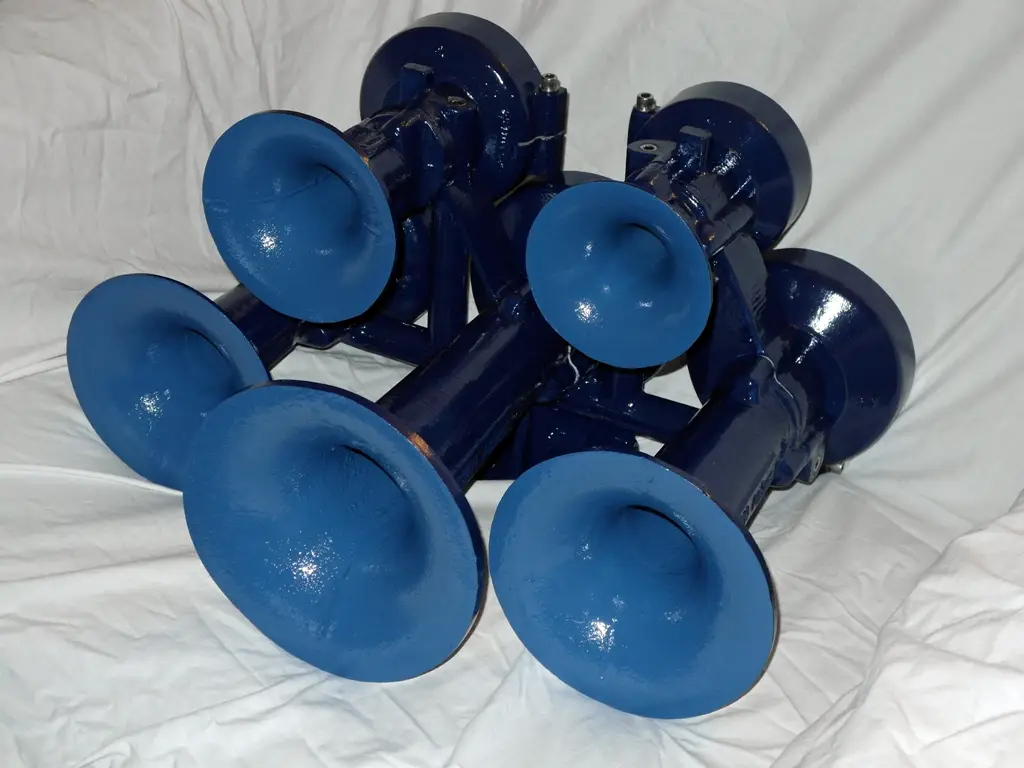
HornBlasters recommends two kits for the Cybertruck. The S6 544K went into its showcase build, installed by Restylers Inc. in Crestview, FL. The 244K is the compact pick. Both run the same 1NM compressor at 25 A max, so the power math is identical.
| Spec | Shocker S6 544K | Conductor’s Special 244K |
|---|---|---|
| Price (sale / regular) | $1,219.99 / $1,289.99 | $899.99 / $1,029.99 |
| Horns | Six Shocker bells, 14.75” to 19.50” | Four Shocker XL bells, 12.75” to 19.50” |
| Tank | 5 gallon, 20.5” x 9.5” x 11.5”, 20 lb | 2 gallon, 17” x 6” x 8”, 10 lb |
| Pressure | 150 PSI, restarts at 110 PSI | 150 PSI, restarts at 110 PSI |
| Honk time | 8 to 10 seconds | 3 to 5 seconds |
| Fill 0 to 150 PSI | 6 min 45 sec | 2 min |
| Refill 110 to 150 PSI | 2 min | 35 sec |
| Compressor draw | 25 A max at 12 V | 25 A max at 12 V |
| Warranty | Lifetime on horns, 1 year on compressor, 2 years on other components | Lifetime on horns, 2 years on other components |
The 5-gallon S6 tank is over 20 inches long, which is why the showcase build put it in the bed. The 244K’s 17-inch tank and 10.75-inch compressor are far easier to hide. Full breakdowns are in our Shocker S6 review and Conductor’s Special 244 Nightmare review.
Mounting on a Stainless Steel Truck
The bed is 6 feet long, 4 feet wide, and 67 cubic feet, and the body panels are 300-series stainless at 1.4 mm (1.8 mm for doors). Stainless work-hardens, so use a sharp cobalt bit, slow speed, and cutting fluid. Every hole is permanent on a truck with no paint to touch up, so rivnuts and existing bolt points beat fresh holes. Our frame drilling and mounting hardware guide covers the rivnut method.
Where the HornBlasters build put everything:
- Air tank and compressor: in the cubby at the bottom of the bed, hidden from view.
- Six horns: bolted to the sides of the bed, where the bell openings can drain and the sound clears the tonneau.
- Power: the 110 V-to-12 V kit plugged into an onboard outlet.
The frunk is the alternative for a compact kit. Tesla’s lining removal procedure is short: pull the maintenance panel, unscrew the two bump stops above the headlights, remove the washer cap, pop two trim pieces, take out six 10 mm bolts, and unplug the emergency interior release connector. That exposes the space behind the tub. Our stealth train horn install guide applies directly.
Step-by-Step: Wiring the Outlet Kit
The general flow for the 120 V route. Follow the kit’s printed instructions for connector details.
- Mount the compressor, tank, and horns first, as on any truck. Keep the tank drain accessible.
- Pick your outlet. A cabin outlet is easier to keep sealed; the bed outlets only power up with the outlet cover open.
- Mount the 110 V-to-12 V power supply somewhere dry, with airflow, and plug it in.
- Run the 12 V output through the inline fuse to the compressor’s relay and pressure switch. If your kit uses a relay, our train horn relay wiring guide has the diagram.
- Run the horn button wire to the cab. The kit’s 22 feet of blue and grey wire is meant for this run.
- Test with the truck occupied and in Park before routing anything permanently. The touchscreen shows live outlet wattage under Controls > Outlets & Mods.
Cybertruck-Specific Gotchas
These trip up owners who treat the truck like a gas pickup with a battery.
- The outlets go dead when you walk away. Per the owner’s manual, AC outlets shut off when the truck is unoccupied. Enable Keep Outlets On if you want the compressor to top up while parked; it self-cancels after 12 hours or at 5 percent battery.
- No horn while charging. AC outlets are disabled whenever a charging cable is connected, even if the truck isn’t actively charging. Not a driving problem, but don’t panic when the button does nothing at a charger.
- Cold weather and GFCI trips. Tesla lists very low temperatures and GFCI or overcurrent detection as reasons an outlet may shut down. Check the touchscreen before assuming a blown fuse.
- Not every trim has outlets. Tesla’s manual notes some configurations ship without cargo bed outlets. Confirm what your truck has before ordering the kit.
- UL-listed devices only. That is Tesla’s caution for its AC outlets, so skip no-name power supplies.
- The low-voltage battery is tiny. The 48 V auxiliary battery weighs under 5 pounds. Never feed a compressor from it through any path other than the 400 W feeds.
A train horn on a nearly silent EV is genuinely useful at highway speed, but it’s subject to the same state horn laws as any vehicle. Check your state’s page in our legal section first.
Keep reading
- Train Horn on a Tesla or EV: Frunk Install, 12V & Amp Limits
- 12V vs 24V Train Horns & Compressors: Which Do You Need?
- Train Horn Amp Draw, Fuse Size & Wire Gauge
- HornBlasters Shocker S6 Train Horn Review
- Stealth Train Horn Install: Hiding Horns, Tank & Compressor
Sources
- Tesla Cybertruck DIY: Connecting Accessories to the 48V Power Feeds — two 400 W feeds, 28/44–50/58 V range, wire colors, only-approved-tap warning, frunk lining removal steps
- Tesla Cybertruck Owner’s Manual: Cargo Bed Outlets — 20 A per outlet pair, 40 A combined, 110 LRA surge, unoccupied shutoff, Keep Outlets On, charging-cable and GFCI disable conditions, UL caution
- HornBlasters Tesla Cyber Truck Train Horn Install Kit (WK-CT) — $99.99 / $119.99 price, 110 V-to-12 V converter, 50 A, 22 ft wire, fuse holder, warranty
- HornBlasters 2024 Tesla Cyber Truck Train Horn Installation — Shocker S6 544K build, bed cubby and bed-side mounting, Restylers Inc. installer
- HornBlasters Tesla Cybertruck Train Horn page — recommended kits for the Cybertruck
- HornBlasters Shocker S6 544K Nightmare Edition kit — price, 5 gal tank, 150/110 PSI, 25 A, honk and fill times, dimensions, warranty (lifetime horns / 1-year compressor / 2-year other components)
- HornBlasters Conductor’s Special 244K Nightmare Edition kit — price, 2 gal tank, 25 A, honk and fill times, dimensions, warranty
- T Sportline Cybertruck 48V-to-12V Power Conversion System — $95, 350 W continuous, behind-frunk-tub mounting
- iJDMTOY 48V Step-Down 12V 300W Converter for Cybertruck — $35.99, 25 A / 300 W, IP67
- Battery Design: Cybertruck 48V Auxiliary Battery vs 12V & 16V — 41–42 V observed operating voltage, 4.8 lb battery weight
- Wikipedia: Tesla Cybertruck — 48 V architecture and Etherloop, 300-series stainless at 1.4/1.8 mm, bed 6 ft x 4 ft x 67 cu ft, five outlets and 9.6 kW Powershare
- Basenor: Cybertruck Powershare Explained — outlet layout by trim, 120 V/20 A and 240 V/40 A ratings
- Notebookcheck: Cybertruck runs washing machine in traffic — real-world confirmation that bed outlets stay live while driving
Frequently asked questions
Quick answers to the questions people ask most about this topic.
- Can you put a train horn on a Tesla Cybertruck?
- Yes, but not by wiring a 12V kit into the truck. The Cybertruck's low-voltage system runs at a nominal 44 to 50 volts, so the practical route is a 110V-to-12V power supply plugged into one of the truck's onboard 120V outlets. HornBlasters sells a $99.99 Cybertruck install kit with a 50-amp converter for exactly this.
- Can I run a train horn compressor off the Cybertruck's 48V power feed?
- It's marginal. Each of Tesla's two 48V accessory feeds is limited to 400 watts, and a typical kit compressor draws up to 25 amps at 12 volts, which is about 300 watts running before converter losses and startup surge. Aftermarket 48V-to-12V converters are rated 300 to 350 watts, so they sit right at their ceiling.
- Do the Cybertruck's 120V outlets work while driving?
- Yes. Tesla's manual says the outlets shut off when the truck is unoccupied, and a Cybertruck has been filmed running a washing machine from its bed outlets in city traffic. The outlets are disabled while a charging cable is connected, so the horn will not work at a charger.
- Which train horn kit fits a Cybertruck best?
- HornBlasters recommends the Shocker S6 544K, which went into its showcase Cybertruck build with the air system hidden in the bed cubby and six horns bolted to the bed sides, or the more compact Conductor's Special 244K. Both use a 25-amp 1NM compressor at 150 PSI.
- How much power does a train horn pull from the Cybertruck's outlet?
- At the compressor's 25-amp maximum on 12 volts, the load is about 300 watts, which is roughly 2.5 amps at 120 volts before conversion losses. Tesla allows 20 amps across each pair of 120V outlets and rates them for compressor starts up to 110 LRA.
Related reviews & guides
Train Horn on a Tesla or EV: Frunk Install, 12V & Amp Limits

Running a Train Horn Off Your Air Suspension Tank: Setup Guide

Where to Mount a Train Horn Compressor: Heat, Water & Vibration

Dual Compressor Train Horn Setup: Twice the Fill Speed, Worth It?
How to Remove a Train Horn: Uninstall, Plug Holes & Go Stock