How to Install a Train Horn on a Jeep Wrangler JK (2007–2018)
Train horn install for Jeep Wrangler JK — Wrango JKU bracket bolt-on, underbody chassis mounting, OEM horn fuse-tap wiring, 2-door vs Unlimited 4-door fitment.
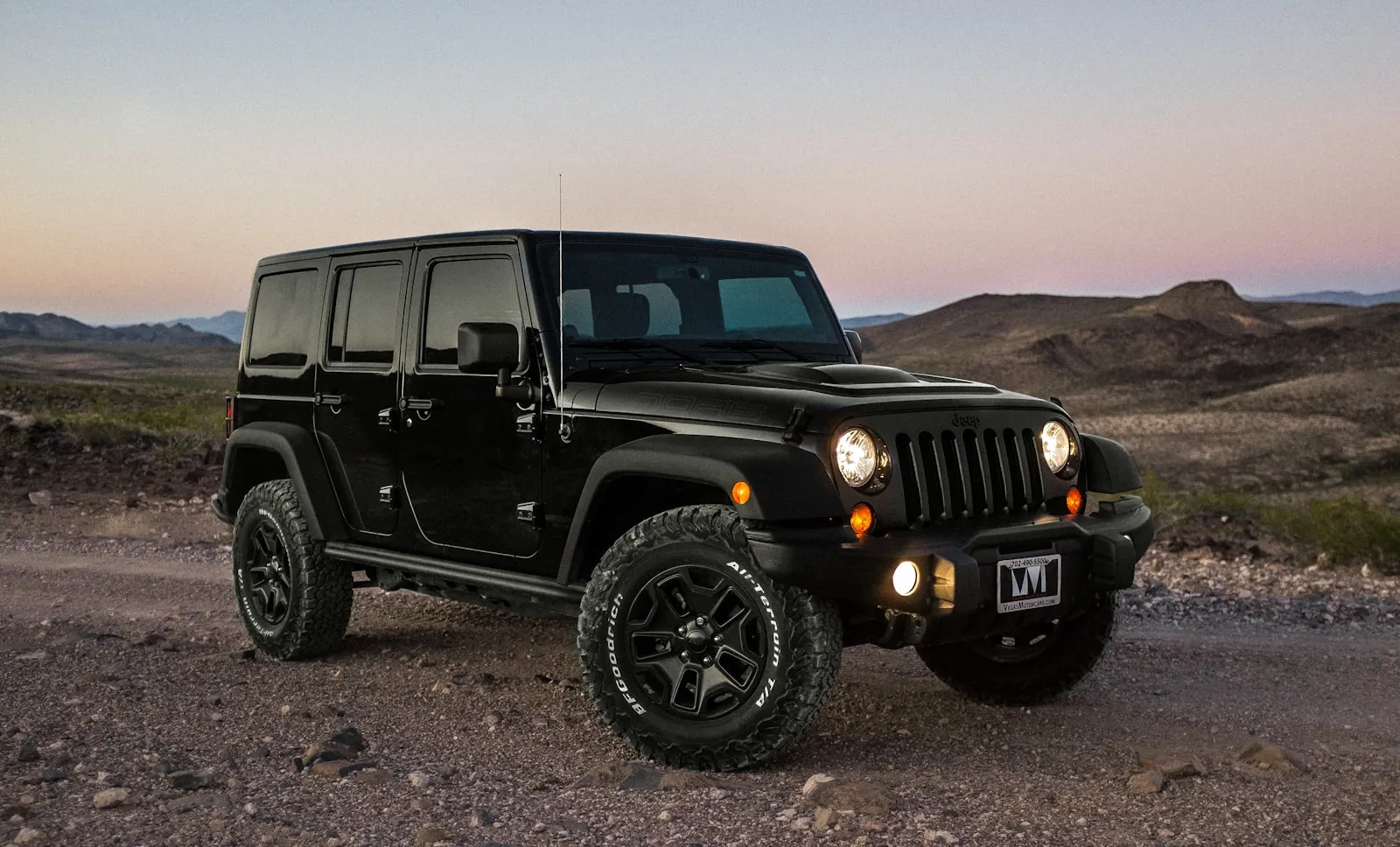
The Jeep Wrangler JK (2007–2018) was the predecessor to the JL. Like the JL it has no under-bed spare-tire well — the spare hangs off the rear tailgate, and the underbody is occupied by skid plates and driveline components. HornBlasters built the Wrango JKU bracket specifically for the 4-door Unlimited (JKU) variant, which became the most common train-horn install on the JK platform. This guide consolidates the HornBlasters Wrango JKU page, JKowners.com forum threads, and Quadratec’s Kleinn JK kit listings.
For the newer JL platform see our Wrangler JL install guide. For other Jeeps see Wrangler Gladiator and Grand Cherokee.
- Difficulty
- Moderate
- Underbody work + drilling
- Time
- 4–5 hr (Wrango bracket)
- 6–8 hr custom install
- Cost
- $1,200–$5,000
- Kit + bracket + parts
- Best mount
- Underbody chassis
- Wrango JKU bracket
- Variants
- JK 2-door / JKU 4-door
- Plus Rubicon, Sahara, Sport
- Air system
- 5-gal tank min
- Or 2-gal Conductor 228H
Quick stats
- Difficulty: Moderate. Underbody mount, some drilling. Easier with a lift but workable on jack stands.
- Time: 4–5 hours with the Wrango JKU bracket; 6–8 hours for a custom install or 2-door JK fab.
- Cost: $1,200–$1,500 entry kits up to $5,000+ for a full HornBlasters Shocker XL or Nathan AirChime K5LA install.
- Tools: Socket set, drill, wire crimpers, multimeter, MICRO2 add-a-circuit adapter, torque wrench.
- Best mount option for most builds: Underbody chassis with the Wrango JKU bracket. Keeps the install invisible from above and protected by the skid-plate geometry.
Mounting options for the JK platform
Underbody chassis (recommended — JKU 4-door 4WD V6)
HornBlasters’ Wrango JKU Horn Kit is engineered specifically for the 2007–2018 Wrangler JKU 4-door 4WD V6. The bracket bolts to the underside of the chassis with some drilling required. Trumpets project rearward and downward, protected by the skid plates from road debris.
Compatibility:
- 2007–2018 JKU 4-door 4WD V6 — engineered fit
- 2-door JK — bracket doesn’t fit cleanly; custom underbody fabrication needed
- 2WD versions — uncommon on JK, but bracket clearance differs from 4WD
Kleinn bolt-on JK kit
Quadratec sells a Kleinn Air Horns Bolt-On Train Horn Kit for 2007–2018 JK. Pre-bracketed system that fits both 2-door JK and 4-door JKU.
Behind front bumper (custom)
Some builders mount trumpets behind the JK’s stock or aftermarket steel bumper, with tank and compressor in the rear cubby (JKU only). Less stealthy; more weather-exposed.
Engine bay battery-tray mount
Per JKowners.com discussions, some JK builders mount compact horns in the engine compartment near the battery tray. Tight envelope but accessible for service.
Recommended kits
Three kits ordered by price tier:
- Kleinn Bolt-On JK Kit (Quadratec) — Direct-fit for 2007–2018 JK and JKU. Pre-bracketed with Kleinn-brand horns. Best fit for buyers who want a turnkey install.
- HornBlasters Wrango JKU Bracket + Conductor’s Special 228H — Bracket plus the 228H 147.7 dB kit. Fits 4-door JKU.
- HornBlasters Nathan AirChime K5LA Kit — $4,999.99–$5,199.99. Real locomotive horn. The Wrangler’s underbody is one of the more challenging chassis to host the K5LA’s 38 lb weight; verify your specific build can support it.
For portable / no-install alternatives see Milwaukee M18 and DeWalt 20V MAX hubs.
Step-by-step (Wrango JKU bracket on a 4-door JKU)
This sequence assumes a 2007–2018 Jeep Wrangler JKU 4-door 4WD V6 with the HornBlasters Wrango JKU bracket and a 2-gallon Conductor’s Special 228H or 5-gallon Conductor’s Special 544 air system. Total time: 4–5 hours.
- Disconnect battery negative terminal.
- Lift the front of the Jeep on jack stands.
- Remove any underbody panels or skid plates in the way of the chassis section where the bracket will mount.
- Test-fit the Wrango JKU bracket against the underside chassis. Mark holes per HornBlasters’ instructions.
- Drill marked holes and bolt the bracket to the chassis. Torque per included instructions.
- Mount the train horn to the bracket using the supplied U-bolts or clamps. Trumpets pointing rearward and slightly down.
- Mount the air tank — 2-gallon 228H tank can fit within the bracket envelope; 5-gallon tank often goes in the rear cubby (JKU only).
- Mount the compressor to the chassis or alongside the tank. Position to avoid exhaust heat.
- Run air lines between compressor, tank, solenoid valve, and horn. 1/2″ PTC fittings.
- Run the compressor power wire (8 AWG positive + ground) from the engine bay battery. Inline 30 A fuse within 12″ of battery positive.
- Run the solenoid trigger wire (18 AWG) from the cab to the solenoid.
- Tap into the OEM horn fuse circuit (MICRO2 add-a-circuit method, see below).
- Ground the solenoid to the chassis on bare metal.
- Reconnect battery, prime the system (≈ 6:45 to fill 5-gallon tank from 0 → 150 PSI; ≈ 3:05 for the 2-gallon 228H).
- Test fire the horn first by manually shorting the solenoid trigger to 12 V, then via the OEM steering wheel button.
- Reinstall any underbody panels removed in step 3.
Wiring to the steering wheel button
The JK’s OEM horn fuse lives in the under-hood Power Distribution Center. Same MICRO2 add-a-circuit method as the JL and the F-150:
- With battery disconnected, locate the horn fuse in the engine bay PDC.
- Remove the original horn fuse using a fuse puller.
- Insert a MICRO2 add-a-circuit adapter with the original fuse on the interior terminals.
- Insert a 10 A MICRO2 fuse on the exterior terminals.
- Crimp 18 AWG wire to the adapter’s pigtail and route to the solenoid.
- Ground the solenoid’s negative terminal to the chassis.
- (Optional) Splice a cab-mounted toggle for arm/disarm.
- Reconnect battery, press steering wheel horn button — both OEM horn and train horn fire together.
For the universal wiring topology, see /install/by-task/wiring-diagram/.
Common problems
Distilled from JKowners.com, Wranglerforum.com, and HornBlasters Wrango JKU page:
- Wrango bracket only fits 4-door JKU 4WD V6. 2-door JK builders need custom fab. Verify variant before ordering.
- Skid plate clearance. Rubicon trims have full-belly skids that interfere with the Wrango bracket. Some skid removal or modification required.
- OEM horn stops working after fuse-tap. MICRO2 adapter inserted backwards. Original fuse on interior terminals; new 10 A trigger fuse on exterior terminals.
- Trail vibration loosens fittings. JKs see significant chassis flex off-road. Use thread-locker on every NPT fitting; recheck after the first off-road outing.
- Compressor near exhaust heat. Verify clearance — V6 exhaust runs along the passenger side and can transfer heat to a poorly-located compressor.
- Reversed compressor polarity. Symptom: motor grinds. Fix: swap +/− compressor leads.
- Air leak at NPT fittings. Use Teflon tape on every NPT thread; do not Teflon-tape PTC fittings.
Legal reminder
A train horn install on a Wrangler JK is legal in most U.S. states for the horn hardware itself, but using it on a public road typically violates state vehicle codes. Off-road use is broadly unrestricted. See the legal hub and state legality lookup.
Sources
- HornBlasters — Wrango JKU Horn Kit (2007–2018 JKU V6 4WD) (engineered-fit bracket details)
- HornBlasters — Wrango Installation Brackets collection
- HornBlasters — Ray’s Wrangler Train Horn Install
- Quadratec — Kleinn Air Horns Bolt-On Train Horn Kit for 2007–2018 JK (Kleinn-branded direct-fit)
- JKOwners.com — Train Horn Installation discussion
- Wranglerforum.com — Train Horn Mounting Locations
- Wranglerforum.com — Best place to mount train horns discussion
We do not perform hands-on installs. This guide aggregates publicly available install documentation and community discussions. Verify all wiring against your vehicle’s year-specific service manual before powering up.