Train Horn Wiring Diagram: Complete Guide
Train horn wiring diagrams — compressor relay circuit, solenoid valve trigger, OEM-horn fuse tap, dedicated toggle. Wire gauge, fuse sizing, with-relay vs no-relay.

A train horn install has two completely separate electrical circuits — one to power the air compressor and one to fire the solenoid valve that releases the air to the horn. Most wiring confusion comes from collapsing those into a single mental model. Treat them separately, use a relay on each, and the install becomes mechanical rather than mysterious. This guide consolidates wiring procedures from HornBlasters’ official manuals, Kleinn install documentation, and community schematics.
- Circuits required
- 2 independent
- Compressor + solenoid
- Relays
- 1–2 SAE 5-pin
- One per high-current load
- Compressor fuse
- 30–35 A
- 1NM-class, 12V DC
- Solenoid fuse
- 5–10 A
- Driver coil current
- Compressor wire
- 10–12 AWG
- Battery → relay → compressor
- Trigger wire
- 16–18 AWG
- Button / OEM tap
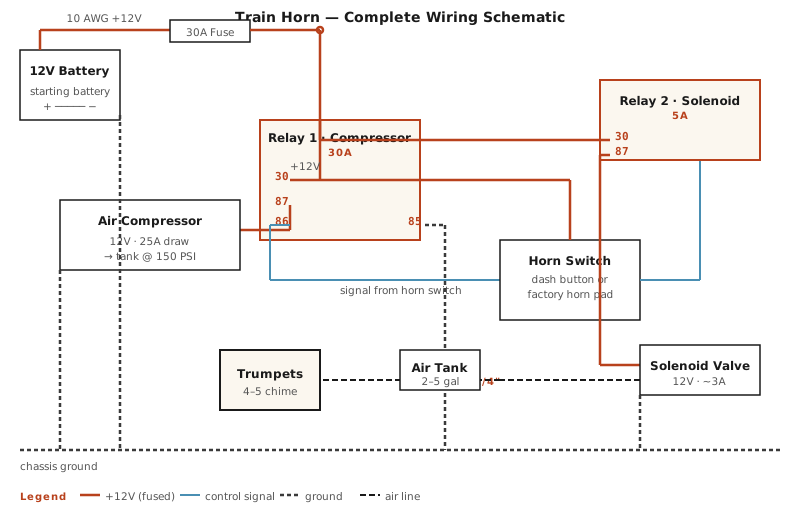
The two circuits, isolated
Circuit A — Compressor. Always-on (or accessory-keyed) high-current loop that fills the air tank. Cycles automatically based on tank pressure via a normally-closed pressure switch. Typical draw: 25 A continuous on a 1NM-class compressor at 100 PSI (HornBlasters wiring guide).
Circuit B — Solenoid valve. Momentary trigger loop. When energized, opens a normally-closed valve and releases tank air to the horn manifold. Coil draws ~3–5 A peak, then drops to holding current ~1 A. The valve must be on the clean output side of the tank, downstream of any check valves.
The two circuits share only the chassis ground and the battery 12 V source. Everything else is independent: separate fuses, separate relays, separate triggers.
Decision: with relay vs without relay
A relay lets a low-current control signal (a button, a fuse-tap signal, an OEM horn output) switch a high-current load (the compressor motor or the solenoid valve) without melting your switch contacts.
| Scenario | Use a relay? | Why |
|---|---|---|
| Compressor (25 A continuous) | Always | No automotive button is rated for 25 A continuous; running the load through a switch destroys the switch and creates a fire hazard. |
| Solenoid valve (~3–5 A peak) | Recommended | Possible to wire without a relay if the button is rated for at least 10 A, but a relay protects the switch and gives cleaner trigger response. |
| OEM horn fuse-tap to solenoid | Not strictly required | The OEM horn circuit already handles ~5 A through factory wiring; a 10 A MICRO2 fuse on the tap is enough. Relay still recommended for isolation. |
The full with-relay topology is the safest, longest-lived approach and the one HornBlasters and Kleinn document in their official manuals. See our forthcoming with-relay wiring page and without-relay wiring page for the two specific topologies; this page covers the universal patterns that underlie both.
SAE 5-pin relay pinout (universal)
A standard automotive 5-pin SAE relay has these terminal numbers stamped near each pin:
| Pin | Function | Wire size (typical) |
|---|---|---|
| 30 | High-current input from battery (through fuse) | 10 AWG (compressor) or 14 AWG (solenoid) |
| 87 | High-current output to load | 10 AWG (compressor) or 14 AWG (solenoid) |
| 87a | Normally-closed output (rarely used here) | — |
| 85 | Coil ground (often switched via button) | 16–18 AWG |
| 86 | Coil 12 V (often jumpered to 30 with fuse, or fed from accessory) | 16–18 AWG |
When you press the button, the coil between 85 and 86 energizes; the magnet pulls the contact between 30 and 87 closed; high current flows through the load. Per HornBlasters’ wiring guide: Pin 30 takes 10-gauge red wire from the battery via a 35 A inline fuse; Pin 87 connects directly to the compressor positive lead; Pin 85 wires to the push-button and then to chassis ground; Pin 86 is jumpered back to Pin 30 with 18-gauge wire (HornBlasters).
Compressor wiring (Circuit A)
   [Battery + 12V]
         │
         │  (10 AWG red, 35 A inline fuse within 12" of battery+)
         │
   ┌─────┴──────────────┐
   │                    │
   │  PIN 30            │
   ├──── Relay ─────────┤
   │  PIN 87            │
   └─────┬──────────────┘
         │
         │  (10 AWG red)
         ▼
    [Compressor +]
         │
         ▼
    [Compressor − ]── 10 AWG black to chassis ground
                       (or direct to battery −)

  Coil side of relay:
  PIN 86 ── 18 AWG ──┐
                     ├─ pressure switch (normally closed) ── chassis ground
  PIN 85 ── 18 AWG ──┘

  Pressure switch opens at cut-out PSI (e.g. 150 PSI),
  closes at cut-in PSI (e.g. 110 PSI). Relay coil
  follows; compressor cycles automatically.
Key points:
- Inline fuse must be within 12 inches of the battery positive terminal — protects the wire from a short anywhere downstream.
- The compressor ground is sized the same as the positive feed (10 AWG). Engineers commonly under-size grounds and the compressor runs hot or sluggish.
- The pressure switch is in the relay coil circuit, not the high-current circuit. A typical pressure switch is rated for only a few amps; running the compressor’s full 25 A through it would weld the contacts shut.
- Do not skip the pressure switch. Without it, you’re holding the button until the tank explodes (or the compressor burns out).
Solenoid valve wiring (Circuit B)
   [Battery + 12V]
         │
         │  (14 AWG, 10 A inline fuse)
         │
   ┌─────┴──────────────┐
   │  PIN 30            │
   ├──── Relay ─────────┤
   │  PIN 87            │
   └─────┬──────────────┘
         │
         │  (14 AWG)
         ▼
    [Solenoid valve +]
         │
         ▼
    [Solenoid valve − ]── 14 AWG to chassis ground

  Coil side of relay:
  PIN 86 ── 18 AWG ── +12V (accessory or fused)
  PIN 85 ── 18 AWG ── trigger source ── chassis ground
                       │
                       └─ from OEM horn fuse tap
                          OR cab-mounted push button
                          OR cab-mounted toggle switch
Key points:
- The solenoid is a momentary load — only energized while the trigger button is held. Don’t run a high-amp continuous fuse here; 10 A is plenty.
- The trigger source on Pin 85 is what determines how the horn fires:
- OEM horn fuse tap (via MICRO2 add-a-circuit) — fires whenever you press the steering wheel horn button. Cleanest install, no cab wiring.
- Cab-mounted push button — fires only when you press the dedicated train-horn button. Quieter daily driving.
- Cab-mounted toggle switch — fires whenever the toggle is on AND the OEM horn is pressed. Lets you “arm” the train horn for specific situations.
Trigger source: three topologies
Topology 1 — OEM horn fuse tap (no extra cab wiring)
[Steering wheel horn button] ─── OEM horn circuit
                                  │
[Engine fuse box] ── horn fuse ───┤
                                  │
[MICRO2 add-a-circuit adapter]
        │
        ├── interior terminals: original horn fuse (OEM horn keeps working)
        │
        └── exterior terminals: 10 A fuse → 18 AWG → Pin 85 of solenoid relay
                                                       │
                                                       └─ ground
Used by most HornBlasters install pages, including the F-150 OEM-tap procedure. The MICRO2 adapter must be inserted with the original fuse on the interior side so the OEM horn keeps working; the new 10 A fuse on the exterior side becomes the train-horn trigger source.
Topology 2 — Cab-mounted push button
[Battery + 12V] ── 5A inline fuse ── 18 AWG ─── push button ─── 18 AWG ─── Pin 85 of solenoid relay
                                                                              │
                                                                              └─ ground
A simple SPST momentary push button on the dash. Holds train horn separate from the OEM horn entirely. Pin 85 receives 12 V when the button is pressed; the relay fires the solenoid for as long as the button is held.
Topology 3 — Toggle + OEM tap (best of both)
[Engine fuse box horn fuse] ─ MICRO2 adapter ─ 18 AWG ─ SPST toggle ─ 18 AWG ─ Pin 85 of solenoid relay
                                                          │
                                                          └─ When toggle is OFF: OEM horn only.
                                                             When toggle is ON: both fire together.
Toggle in cab acts as an “arm/disarm” switch. When off, only the factory horn fires when you press the steering wheel button. When on, both fire together. Best for daily drivers who don’t want the train horn going off every time they tap the OEM horn.
Wire gauge by run length
Wire gauge depends on amperage and one-way run length. Quick reference, sized to keep voltage drop below 3% on a 12 V system:
| Load | Run length (one-way) | Recommended AWG |
|---|---|---|
| Compressor (25 A) | up to 6 ft | 10 AWG |
| Compressor (25 A) | 6–12 ft | 8 AWG |
| Compressor (25 A) | 12+ ft | 6 AWG |
| Solenoid (5 A) | up to 10 ft | 14 AWG |
| Solenoid (5 A) | 10–20 ft | 12 AWG |
| Trigger / coil (≤ 1 A) | any | 16–18 AWG |
For a custom calculation that includes voltage drop tolerance and ABYC ampacity tables, use the wire gauge calculator.
Common wiring mistakes
Distilled from HornBlasters wiring documentation and threads on TheDieselStop, the12volt installbay, and Toyotanation:
- Reversed compressor polarity. Symptom: motor grinds or hums but doesn’t pump. Fix: swap the compressor +/− leads. Per HornBlasters: “grinding indicates reversed polarity at compressor connections.”
- Trigger relay always-on. Symptom: solenoid stays open; horn keeps blasting. Fix: verify Pin 85 is going through your trigger source, not directly to ground.
- Pressure switch in the wrong circuit. Symptom: compressor either runs continuously or never starts. The pressure switch belongs in the coil circuit (Pin 86 or 85), not in the high-current line.
- Inline fuse too far from battery. Symptom: fuse blows during a short-circuit fault but the wire harness has already melted. Fix: the inline fuse must sit within 12” of the battery positive terminal.
- Bad ground. Symptom: compressor runs slow, lights dim, intermittent operation. Fix: ground stud must be on bare metal — strip paint, use a ring terminal, torque tight, dab with dielectric grease.
- Under-sized wire. Symptom: voltage at the compressor sags below 11 V under load; compressor underperforms. Use the gauge table above; when in doubt, go one size larger.
- No flyback protection on solenoid. Symptom: relay or trigger circuit eventually fails. The solenoid coil produces a back-EMF spike when de-energized; many automotive solenoid valves include an internal diode but verify on the spec sheet. If absent, add a 1N4007 diode across the coil (cathode to +, anode to −).
- Both circuits sharing a single fuse. The compressor’s continuous draw will pop a fuse sized for the solenoid, and a fuse big enough for the compressor leaves the solenoid wire under-protected. Use separate fuses sized to each load.
Diagnostic procedure
If the system doesn’t fire, work through these checks in order:
- Battery voltage at the relay Pin 30. Multimeter from Pin 30 to chassis ground. Should read 12.4–14.4 V. If absent, fuse is blown or run is broken.
- Coil voltage when triggered. Press button or activate trigger. Multimeter from Pin 86 to Pin 85. Should read battery voltage. If absent, trigger circuit is broken.
- Output voltage when triggered. Multimeter from Pin 87 to chassis ground while button is pressed. Should read battery voltage. If absent, relay is bad — swap a known-good unit.
- Compressor or solenoid voltage at the load. Multimeter at compressor or solenoid terminals while triggered. Should read battery voltage minus a small voltage drop (< 0.5 V). If reading is much lower, wire is undersized or a connection is bad.
- Air system pressure. Tank gauge should read between cut-in and cut-out PSI. If pressure is low, the issue isn’t electrical — check air leaks, compressor pumping, or the pressure switch settings.
Sources
- HornBlasters — Wiring the Motorcycle & Truck Electric Air Horns (relay pin assignments, wire gauges, fuse sizing)
- HornBlasters — Instructions & Manuals: Wiring Diagrams and Schematics (kit-specific schematics)
- HornBlasters — How to Wire Dual Air Compressors
- HornBlasters — F-150 OEM Horn Fuse Tap (2018–2020) (MICRO2 add-a-circuit procedure)
- Kleinn — SDKIT17-230/734STD Installation Manual (kit wiring schematic)
- The Diesel Stop — Air horn wiring schematic discussion thread (community troubleshooting)
- the12volt — Air horns, wiring is confusing! discussion (common mistake catalog)
Wire-gauge sizing follows the wire gauge calculator (ABYC E-11 / NEC Table 310.16). Voltage-drop budgets and Peukert corrections for battery-driven loads are documented at /tools/battery-drain/. We do not perform hands-on wiring tests; verify all wiring against your kit manufacturer’s manual and your vehicle’s service documentation before powering up.