How to Install a Train Horn on a Ford Bronco (2021–2026)
Train horn install for the 2021+ Ford Bronco — underbody chassis mounting, OEM horn fuse-tap wiring, 2-door vs 4-door cubby fitment, Sasquatch trim notes.
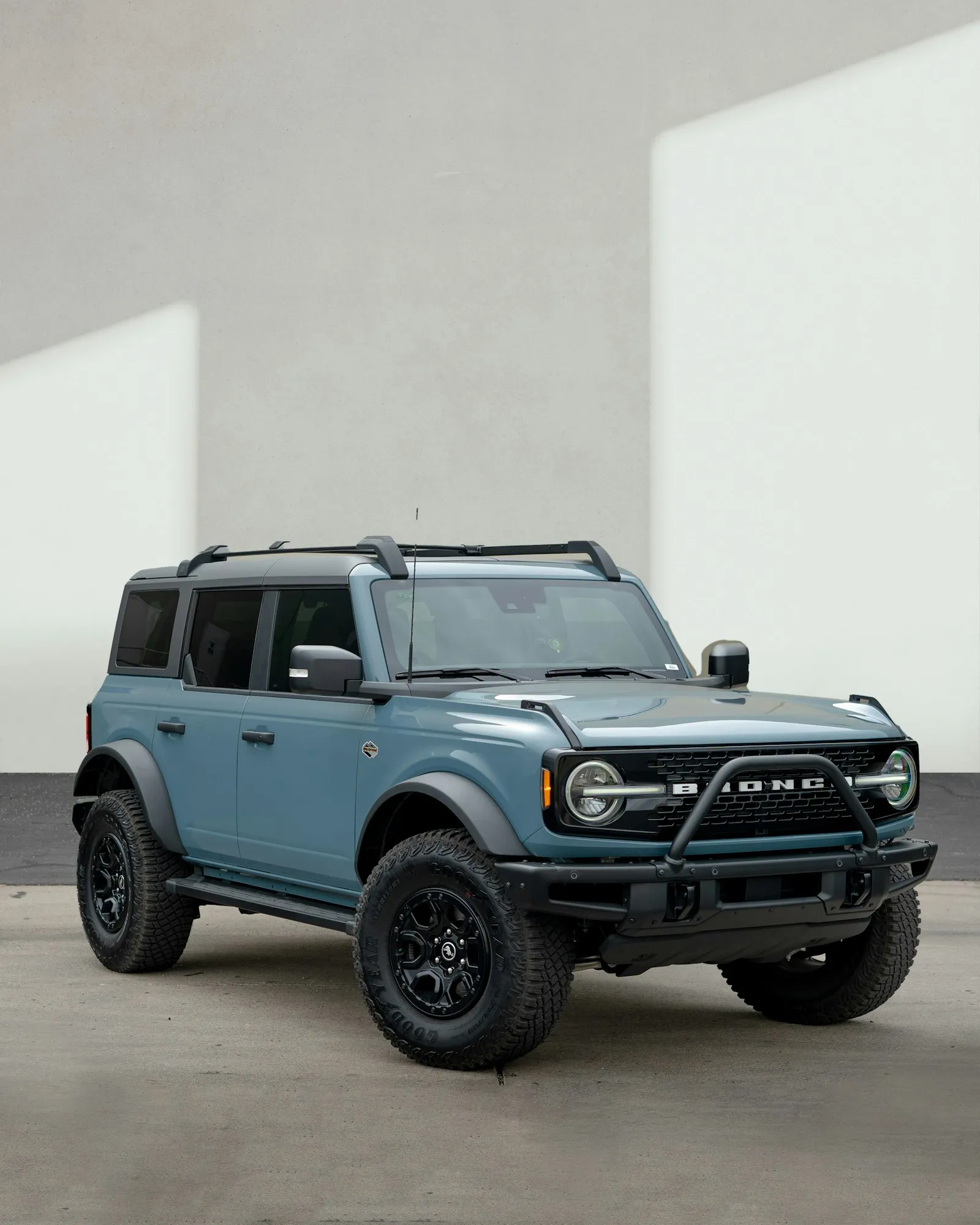
The 2021+ Ford Bronco (6th-generation) competes directly with the Jeep Wrangler, with similar body-on-frame architecture and removable doors / roof panels. Like the Wrangler, the Bronco has no under-bed spare-tire well — the spare hangs on the rear tailgate. Train horn installs therefore use underbody chassis mounting, engine bay battery-tray mounting, or rear cargo cubby (4-door only). Bronco-specific aftermarket brackets are still maturing in 2026 since the platform is relatively new; expect more options each model year.
- Difficulty
- Moderate
- Underbody work + fender liners
- Time
- 4–5 hr (universal kit)
- 6–8 hr custom install
- Cost
- $1,200–$5,000
- Kit + bracket + parts
- Best mount
- Underbody chassis
- Or rear cubby (4-door)
- Variants
- 2-door / 4-door / Raptor
- Plus Sasquatch package
- Air system
- 5-gal tank min
- Or 2-gal Conductor 228H
Quick stats
- Difficulty: Moderate. Bronco underbody is busy with skid plates, transfer case, and rear axle.
- Time: 4–5 hours with a universal STL bracket; 6–8 hours for custom underbody mounting.
- Cost: $1,200 entry kits up to $5,000+ for a HornBlasters Shocker XL or Nathan AirChime K5LA install.
- Tools: Socket set, drill, wire crimpers, multimeter, MICRO2 add-a-circuit adapter, plastic trim-removal tools.
- Best mount option for most builds: Underbody chassis with a universal STL bracket. The Bronco shares its frame architecture with the Ranger, so Ranger-fit brackets often work with adaptation.
Mounting options on the 6th-gen Bronco
The Bronco has three viable mount strategies, similar to the Jeep Wrangler JL:
Underbody chassis (recommended — 4-door)
A universal underbody STL bracket bolts to the chassis between the frame rails, ahead of or behind the rear axle. Trumpets project rearward and downward, protected by the skid plate geometry. The Sasquatch package’s full-belly skid plates may need partial removal for clearance.
Engine bay battery-tray mount
The Bronco’s engine bay has space near the secondary battery tray for a compact horn unit. Useful if you want easy service access. Not feasible on the 4xe-equivalent hybrid setup (if Ford releases one) due to high-voltage component placement.
Rear cargo cubby (4-door only)
The 4-door Bronco has a small cubby in the rear cargo area (behind the rear seat) that fits a 2-gallon Conductor 228H tank cleanly. Compressor and trumpets go underbody.
Behind front bumper (custom)
Some builders mount trumpets behind the bumper, with tank and compressor in the engine bay. Visible mount, more weather-exposed.
Recommended kits
Three kits ordered by price tier:
- HornBlasters Conductor’s Special 228H — $649.99–$749.99. 147.7 dB, 2-gallon tank. Compact enough for the rear cubby on 4-door Broncos.
- HornBlasters Shocker XL Kit — $1,800–$2,200. 5-gallon tank gives sustained 5–10 sec blasts.
- HornBlasters Nathan AirChime K5LA Kit — $4,999.99–$5,199.99. The K5LA’s 38 lb is heavy for the Bronco’s underbody; verify mount-point load rating before final commit.
For portable / no-install alternatives see Milwaukee M18 and DeWalt 20V MAX hubs.
Step-by-step (universal STL bracket on a 4-door Bronco)
This sequence assumes a 2021+ Ford Bronco 4-door with a universal underbody bracket and a 5-gallon Conductor’s Special 544 air system. Total time: 4–5 hours.
- Disconnect battery negative terminal.
- Lift the rear of the Bronco on jack stands (or use a lift).
- Remove any underbody panels or skid plates in the way of the chassis section. Sasquatch trims have full-belly armor that may need partial removal.
- Test-fit the universal STL bracket against the underside chassis. Mark holes per bracket-specific instructions.
- Drill marked holes and bolt the bracket to the chassis. Torque per included instructions.
- Mount the train horn to the bracket. Trumpets pointing rearward and slightly down. Verify clearance from the rear axle’s full droop position.
- Mount the air tank — 5-gallon tank fits in the rear cargo cubby (4-door) with airline running forward, or within the underbody bracket envelope.
- Mount the compressor to the chassis or alongside the tank. Position to avoid exhaust heat.
- Run air lines between compressor, tank, solenoid valve, and horn. 1/2″ PTC fittings.
- Run the compressor power wire (8 AWG positive + ground) from the engine bay battery. Inline 30 A fuse within 12″ of battery positive.
- Run the solenoid trigger wire (18 AWG) from the cab to the solenoid.
- Tap into the OEM horn fuse circuit (MICRO2 add-a-circuit method, see below).
- Ground the solenoid to the chassis on bare metal.
- Reconnect battery, prime the system (≈ 6:45 to fill 5-gallon tank from 0 → 150 PSI).
- Test fire the horn first by manually shorting the solenoid trigger to 12 V, then via the OEM steering wheel button.
- Reinstall any underbody panels removed in step 3.
Wiring to the steering wheel button
The Bronco’s OEM horn fuse lives in the under-hood Battery Junction Box (BJB) — same general architecture as the F-150. MICRO2 add-a-circuit method:
- With battery disconnected, locate the horn fuse in the engine bay BJB.
- Remove the original horn fuse using a fuse puller.
- Insert a MICRO2 add-a-circuit adapter with the original fuse on the interior terminals.
- Insert a 10 A MICRO2 fuse on the exterior terminals.
- Crimp 18 AWG wire to the adapter’s pigtail and route to the solenoid.
- Ground the solenoid’s negative terminal to the chassis.
- (Optional) Splice a cab-mounted toggle for arm/disarm override.
- Reconnect battery, press steering wheel horn button — both OEM horn and train horn fire together.
For the universal wiring topology, see /install/by-task/wiring-diagram/.
Common problems
Distilled from 2021+ Bronco6G.org and Bronco Forum threads:
- Sasquatch skid-plate clearance. Full-belly skid plates on Sasquatch trims interfere with universal underbody brackets. Partial skid removal or modified bracketing required.
- 2-door vs 4-door cubby space. 2-door Broncos lack the rear cargo cubby that 4-door Broncos have. 5-gallon tank installs on 2-door require underbody-only routing.
- Bronco-specific brackets are nascent. The aftermarket is still developing direct-fit Bronco brackets. Most current installs use universal STL brackets from the F-150 / Ranger family with adaptation.
- OEM horn stops working after fuse-tap. MICRO2 adapter inserted backwards. Original fuse on interior terminals; new 10 A trigger fuse on exterior terminals.
- Reversed compressor polarity. Symptom: motor grinds. Fix: swap +/− compressor leads.
- Fender liner damage during install. Use plastic trim-removal tools (not metal screwdrivers) to remove fender liners. The Bronco’s plastic liners scratch easily.
- Trail vibration. Like the Wrangler, the Bronco sees significant chassis flex off-road. Use thread-locker on every NPT fitting; recheck after first off-road outing.
Legal reminder
A train horn install on a Bronco is legal in most U.S. states for the horn hardware itself, but using it on a public road typically violates state vehicle codes. Off-road use (where a Bronco thrives) is broadly unrestricted. See the legal hub and state legality lookup.
Sources
- HornBlasters — Goliath Mount product page (Goliath bracket family approach; F-150 / Ranger versions adaptable to Bronco)
- HornBlasters — Universal Spare Tire Location bracket reference (similar bracket geometry on F-150 platform applies with adaptation)
- HornBlasters — Wrango JLU bracket reference (closest analogous platform — Jeep Wrangler JLU 4-door — for underbody mounting approach)
We do not perform hands-on installs. This guide aggregates publicly available install documentation and community discussions for the early 2021+ Bronco aftermarket. Verify all wiring against your vehicle’s year-specific service manual and consult Bronco-specific forums for the most current bracket fitment data before powering up.