Train Horn Wiring Diagram With Relay
Train horn wiring with relay — SAE 5-pin relay topology, compressor and solenoid circuits, OEM horn fuse-tap to relay coil, wire gauges and fuse sizing.

The with-relay topology is the recommended train horn wiring approach for any tank-fed install. A standard SAE 5-pin automotive relay lets a low-current trigger signal (a button, fuse-tap, or OEM horn signal) switch a high-current load (the 25 A compressor or 5 A solenoid) without melting any switch contacts. This page is the relay-specific deep-dive; for the universal wiring topology covering both compressor and solenoid circuits, see /install/by-task/wiring-diagram/. For the (limited) cases where you can skip the relay, see /install/by-task/wiring-without-relay/.
- Difficulty
- Moderate
- Standard SAE relay knowledge
- Time
- ~1.5 hours
- Compressor + solenoid relays
- Relay count
- 2 (recommended)
- One per high-current load
- Compressor relay
- Pin 30 → battery 35A fuse
- Pin 87 → compressor +
- Coil power
- ~100 mA
- Pin 86 to trigger source
- Inline fuse: trigger
- 10A on coil circuit
- Sized to relay coil current
SAE 5-pin relay pinout (universal)
A standard 12 V automotive 5-pin SAE relay has these terminal numbers stamped near each pin (per HornBlasters wiring guide):
| Pin | Function | Wire size (typical) |
|---|---|---|
| 30 | High-current input from battery (through fuse) | 10 AWG (compressor) / 14 AWG (solenoid) |
| 87 | High-current output to load | 10 AWG (compressor) / 14 AWG (solenoid) |
| 87a | Normally-closed contact (rarely used in train horn applications) | — |
| 85 | Coil ground (often switched via button) | 16–18 AWG |
| 86 | Coil 12 V (often jumpered to 30 with fuse, or fed from accessory) | 16–18 AWG |
When you press the button: coil between 85 and 86 energizes; magnet pulls the contact between 30 and 87 closed; high current flows to the load.
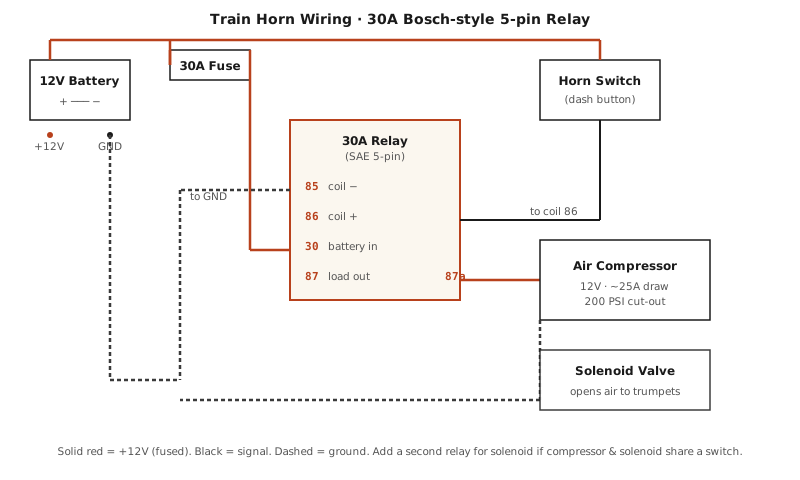
Topology — both circuits with relays
The full wiring diagram with two relays (one for compressor, one for solenoid):
COMPRESSOR CIRCUIT
 [Battery + 12V]
       │
       │  10 AWG, 35A inline fuse within 12" of battery+
       │
   ┌──── Pin 30 ─── COMPRESSOR RELAY ─── Pin 87 ────┐
   │                                                │
   │                                                │  10 AWG
   │                                                ▼
   │                                       [Compressor +]
   │                                                │
   │                                                ▼
   │                                       [Compressor − ] ─── 10 AWG ─── chassis ground
   │
   │  Coil side:
   │  Pin 86 ──── 18 AWG ──── pressure switch (NC) ──── chassis ground
   │  Pin 85 ──── 18 AWG ──── chassis ground (or accessory power if always-on)


SOLENOID CIRCUIT
 [Battery + 12V]
       │
       │  14 AWG, 10A inline fuse
       │
   ┌──── Pin 30 ─── SOLENOID RELAY ─── Pin 87 ────┐
   │                                              │
   │                                              │  14 AWG
   │                                              ▼
   │                                       [Solenoid +]
   │                                              │
   │                                              ▼
   │                                       [Solenoid − ] ─── 14 AWG ─── chassis ground
   │
   │  Coil side:
   │  Pin 86 ──── 18 AWG ──── trigger (button / OEM tap) ──── chassis ground
   │  Pin 85 ──── 18 AWG ──── 12 V via accessory or always-on
For the trigger source on Pin 86, see “Trigger options” below.
Compressor relay wiring step-by-step
- Mount the relay in a dry area near the battery (engine bay PDC vicinity).
- Run 10 AWG red wire from battery + through a 35 A inline fuse (within 12” of battery+) to Pin 30.
- Run 10 AWG red wire from Pin 87 to the compressor + terminal.
- Ground the compressor with 10 AWG black to chassis on bare metal.
- Wire the pressure switch in the relay coil ground path: Pin 86 → 18 AWG → pressure switch → chassis ground. The pressure switch is normally closed at low PSI and opens at the cut-out (typically 150 PSI), de-energizing the relay.
- Connect Pin 85 to chassis ground directly (so the relay coil only energizes when the pressure switch is closed AND Pin 86 has 12 V via accessory power).
Alternative coil-circuit topology: Pin 85 → pressure switch → chassis ground, Pin 86 → 12 V always-on. Either works; the practical difference is which side of the coil is switched.
Solenoid relay wiring step-by-step
- Mount the solenoid relay in the cab or engine bay near the trigger source.
- Run 14 AWG wire from battery + through a 10 A inline fuse to Pin 30.
- Run 14 AWG wire from Pin 87 to the solenoid + terminal.
- Ground the solenoid with 14 AWG to chassis on bare metal.
- Wire the trigger source to Pin 85: typically through a MICRO2 fuse-tap on the OEM horn fuse (see below) or a dedicated cab-mounted button.
- Connect Pin 86 to 12 V via accessory power or always-on.
Trigger options for the solenoid relay
Three common patterns:
OEM horn fuse-tap (preferred)
Use a MICRO2 add-a-circuit adapter on the OEM horn fuse. The original fuse goes in the interior terminals (preserving OEM horn function); a 10 A fuse goes in the exterior terminals. The exterior output becomes the relay coil trigger source. Result: pressing the steering wheel horn fires the train horn too.
Cab-mounted push button
A simple 5–10 A rated SPST momentary push button between Pin 85 and chassis ground. Pressing the button completes the relay coil circuit. Independent of OEM horn.
Toggle + OEM tap
Combine the OEM fuse-tap with a SPST toggle in line. Toggle off = OEM horn only. Toggle on = both fire together. Best of both — the train horn is “armed” only when the toggle is on.
For full topology variants see the universal wiring diagram.
Wire gauge by run length
Wire gauge depends on amperage AND one-way run length (per the wire gauge calculator):
| Load | Run length (one-way) | Recommended AWG |
|---|---|---|
| Compressor (25 A) | up to 6 ft | 10 AWG |
| Compressor (25 A) | 6–12 ft | 8 AWG |
| Compressor (25 A) | 12+ ft | 6 AWG |
| Solenoid (5 A) | up to 10 ft | 14 AWG |
| Solenoid (5 A) | 10–20 ft | 12 AWG |
| Trigger / coil (≤ 1 A) | any | 16–18 AWG |
Common with-relay-wiring problems
- Relay clicks but compressor doesn’t run. Reversed polarity at compressor — swap +/− leads.
- Compressor cycles continuously. Pressure switch is failing or air line has a slow leak. Spray soapy water on every fitting; bubbles mark the leak.
- Solenoid won’t fire when button pressed. Wrong relay pin used — verify Pin 30 has battery voltage, Pin 87 has voltage when coil is energized.
- Inline fuse blows immediately. Short-circuit downstream — disconnect everything and bench-test the relay.
- Pressure switch wired backwards. A normally-closed pressure switch should be CLOSED at low PSI and OPEN at cut-out PSI. If wired backwards, the compressor will run only above cut-out PSI (which is impossible).
- Inline fuse too far from battery. Must be within 12” of battery positive — protects the wire from a short-circuit fault that would otherwise melt the harness before the fuse blows.
- Bad ground. Ground stud must be on bare metal. Strip paint, use ring terminal, torque tight, dab with dielectric grease.
Sources
- HornBlasters — Wiring the Motorcycle & Truck Electric Air Horns (relay pin assignments, wire gauges, fuse sizing — primary reference)
- HornBlasters — Instructions & Manuals: Wiring Diagrams and Schematics (kit-specific schematics)
- HornBlasters — How to Wire Dual Air Compressors (XD-844K dual-compressor wiring)
- HornBlasters — F-150 OEM Horn Fuse Tap (2018–2020) (MICRO2 add-a-circuit procedure)
- Kleinn — SDKIT17-230/734STD Installation Manual (Kleinn-kit relay topology reference)
For the universal wiring topology covering compressor and solenoid circuits side-by-side, see /install/by-task/wiring-diagram/. For when no-relay wiring is acceptable, see /install/by-task/wiring-without-relay/.
We do not perform hands-on wiring tests; verify all wiring against your kit manufacturer’s manual and your vehicle’s service documentation before powering up.