Train Horn Signals & What They Mean
Train horn signal meanings — long-long-short-long for grade crossings, short-short-long for flagman acknowledgment, plus 9 other GCOR/NORAC patterns explained.
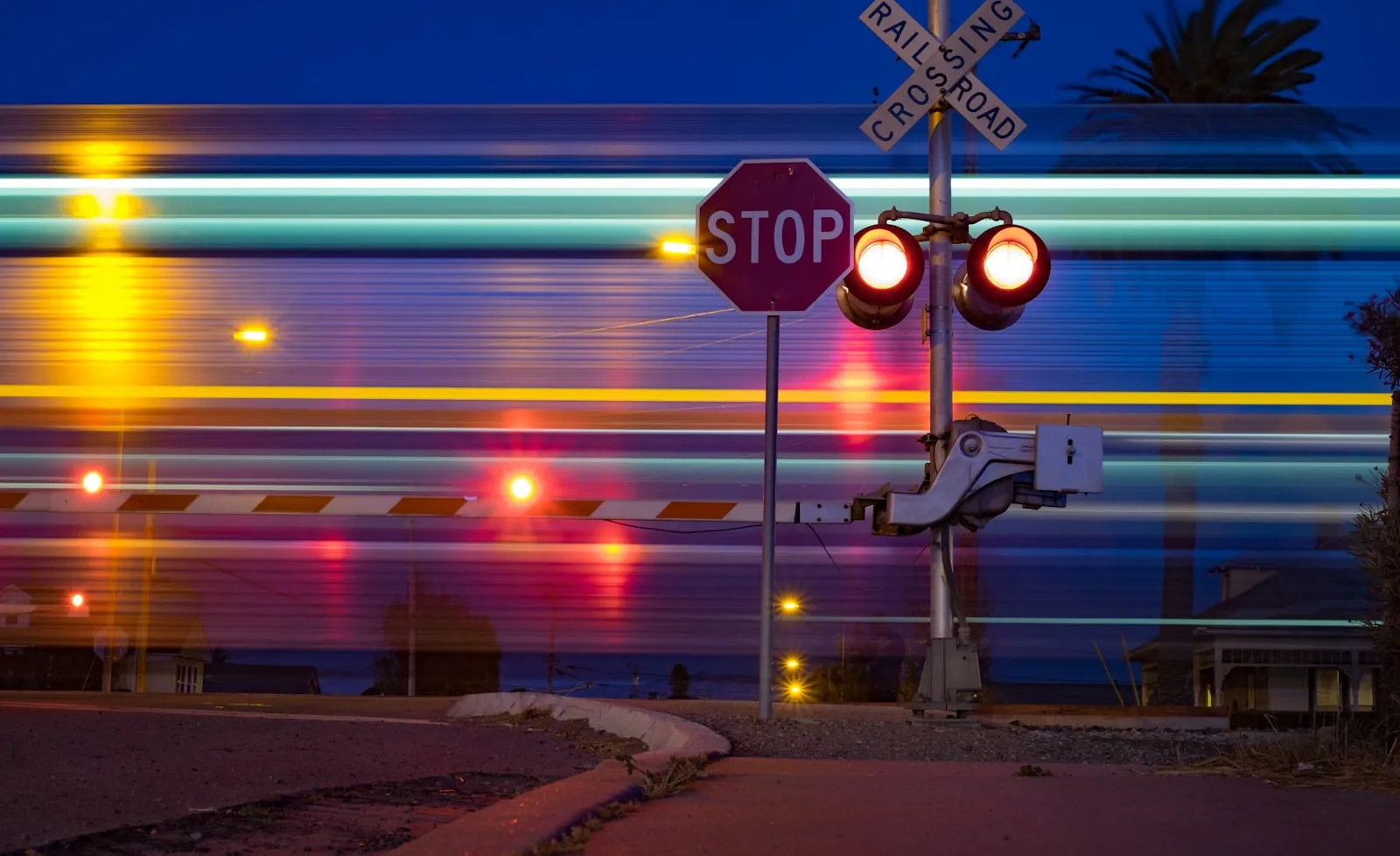
Train horns aren’t random noise — every blast follows a codified pattern with a specific meaning, drawn from the General Code of Operating Rules (GCOR) and NORAC rule books that between them govern most Class I and Class II railroads in the United States (GCOR west of Chicago, NORAC in the Northeast). The most-recognized pattern is the long-long-short-long at every public highway-rail grade crossing, but there are 11 documented signals that engineers use to communicate everything from “applying brakes while standing” to “warning to people on the tracks.”
For the deeper history and federal regulation behind the pattern, see our horn-pattern glossary entry. This page is the practical-meaning reference.
- Codified in
- GCOR + NORAC
- Plus 49 CFR Part 222
- Documented patterns
- ~11
- Per the GCOR signal table
- Long blast
- 2–3 seconds
- Held tone
- Short blast
- ~1 second
- Quick burst
- Most recognized
- — — • —
- Long-long-short-long, grade crossing
- Time-of-day
- 24/7
- No night exception
The full GCOR / NORAC signal table
From Wikipedia: Train horn, the documented signal vocabulary:
| Pattern | Notation | Meaning |
|---|---|---|
| One short | • | Applying air brakes while standing |
| Two long | — — | Proceeding, releasing air brakes |
| Two short | • • | Acknowledging any signal not otherwise provided |
| Three short | • • • | Backing up |
| Four short | • • • • | Calling for signals |
| Long-long-short-long | — — • — | Grade-crossing warning (15–20 sec advance) |
| Short-short-long | • • — | Acknowledging a flagman’s stop signal |
| Single long | — | Approaching passenger station |
| Short-long | • — | Inspect train for brake leak / sticking brakes |
| Long-short | — • | Running against traffic / approaching obstructed view |
| Series of short blasts | • • • • • • | Warning to people or animals on the tracks |
Long blasts are typically held for 2–3 seconds; shorts are about 1 second. Different rule books differ on minor details, but the grade-crossing pattern is universal across all North American railroads.
The grade-crossing signal in detail
The pattern most people will encounter — long-long-short-long, written — — • — — is sounded at every public highway-rail grade crossing. Per 49 CFR Part 222:
- Starts 15–20 seconds before the locomotive reaches the crossing
- For trains over 60 mph, no more than a quarter mile in advance
- Repeated as necessary until the locomotive clears the crossing
- Applies at public crossings only — private crossings follow railroad operating rules
- Time-of-day independent — same rule day or night
Communities can establish a quiet zone under the same rule by installing supplementary safety measures. See quiet zones for the establishment process.
The other patterns in practice
The grade-crossing pattern is the most common signal you’ll hear, but the others have specific operational meanings:
One short (•) — Applying brakes while standing
When a locomotive is stopped (e.g., at a yard, on a siding) and the engineer applies the air brakes, a single short toot announces it to the rest of the crew. Used in switching operations and yard moves.
Two long (— —) — Proceeding, releasing brakes
The opposite of one short — the engineer is releasing the brakes and the train is about to move. Standard pre-departure signal in switching.
Three short (• • •) — Backing up
Sounded when the train is reversing direction, particularly during yard moves or coupling. Audible to ground crew working with the train.
Four short (• • • •) — Calling for signals
Engineer is requesting a signal from the dispatcher or signaling crew — typically because they need a track switch thrown, a hand signal acknowledged, or radio communication established.
Series of short blasts (• • • • • •) — Track warning
When the engineer sees pedestrians, trespassers, vehicles, or animals on or near the tracks, they sound a rapid series of shorts as a warning. Most likely to be heard near rail trespass-prone areas.
Short-long (• —) — Brake inspection
Sounded by the engineer when they suspect a problem with the air brake system (a stuck brake, leak, etc.) and want the conductor or rear-end crew to inspect.
Long-short (— •) — Wrong-direction movement
Used when the train is running against the normal direction of traffic on a section of track (e.g., during track work) or approaching a section with obstructed sight lines.
Single long (—) — Passenger station approach
Mostly heard on commuter and intercity passenger services. The engineer sounds a single sustained long as the train approaches a station platform.
Why the pattern is so distinctive
The long-long-short-long sequence isn’t arbitrary. It’s chosen because:
- It’s not a melody. Doesn’t get confused with car horns, sirens, or industrial noise.
- The asymmetric short blast (in position 3 of 4) is hard to mistake for ambient rhythmic noise.
- The total length (15–20 sec) is long enough to register through environmental masking.
- It pairs with the FRA-mandated 96–110 dB output at 100 ft, which is loud enough to hear over typical traffic but not loud enough to cause immediate hearing damage at the typical bystander distance.
For more on why the pattern exists in this form see our horn-pattern glossary entry.
How aftermarket train horns relate to the pattern
Aftermarket truck-mounted train horns can technically replicate the long-long-short-long pattern — but most kits don’t because:
- 5-gallon air tank limits sustained blasts to about 5–10 seconds before refill is needed. The full pattern takes 15–20 seconds, which exceeds typical tank capacity.
- Most aftermarket users want a single attention-getting blast, not a complete grade-crossing pattern.
- Sounding a recognizable train pattern can attract additional enforcement attention beyond the simple “loud horn” violation.
For aftermarket horn options that can approximate the pattern, see Nathan AirChime K5LA (real locomotive chord) and HornBlasters Shocker XL (147.7 dB four-trumpet).
Hearing the patterns
To hear the actual patterns:
- Visit a railroad grade crossing in your area; you’ll hear the long-long-short-long every time a train passes
- Heritage / tourist railroads — steam-era operators often demonstrate multiple historical signals during excursions
- YouTube railfan channels document specific pattern usage in operating context
- Train Horn soundboard — see our interactive horn soundboard for synthesized chord recordings (the soundboard plays single-sustained tones, not full multi-blast patterns)
Sources
- Wikipedia — Train horn (full GCOR/NORAC signal vocabulary, pattern meanings)
- Federal Railroad Administration — Train Horns and Quiet Zones (49 CFR Part 222) (grade-crossing rule, advance timing)
- Union Pacific — Railroad Safety: Train Horns and Grade Crossing Signals (grade-crossing pattern, 15–20 sec timing, 96–110 dB)
- Wikipedia — General Code of Operating Rules (which railroads operate under GCOR vs. NORAC)
- Trains Magazine — The General Code of Operating Rules (current applicability)
We do not perform hands-on testing — see our methodology.
Frequently asked questions
Quick answers to the questions people ask most about this topic.
- What does the long-long-short-long train horn pattern mean?
- Long-long-short-long, written as two long blasts, one short, and one long, is the grade-crossing warning sounded at every public highway-rail grade crossing. It starts 15 to 20 seconds before the locomotive reaches the crossing and is repeated as necessary until the locomotive clears it.
- How long is a long blast versus a short blast?
- Long blasts are typically held for 2 to 3 seconds, while short blasts are about 1 second each. Different rule books differ on minor details, but these durations are the general standard.
- What does short-short-long mean from a train?
- Short-short-long is the signal for acknowledging a flagman's stop signal. It is one of the documented GCOR and NORAC patterns engineers use to communicate.
- Why do trains blow their horn at night too?
- The grade-crossing horn rule is time-of-day independent, meaning the same pattern is sounded day or night with no night exception. The signal is required 24/7 at public crossings.
- Where are train horn signals officially defined?
- The signals are codified in the General Code of Operating Rules and NORAC rule books that govern most Class I and Class II railroads in the United States, plus the grade-crossing requirement in 49 CFR Part 222. There are about 11 documented patterns.
Related reviews & guides

Why Train Horns Sound Louder at Night and in Cold Weather

Why a Train Horn Changes Pitch as It Passes: Doppler Effect Explained
Do Train Horns Pass DOT Inspection? FMCSA 49 CFR 393.81 Explained
Why Some Train Horns Are Louder Than Others: Trumpet Size & Hz
Train Horn Pranks & the Law: Disturbing the Peace, Assault & Fines