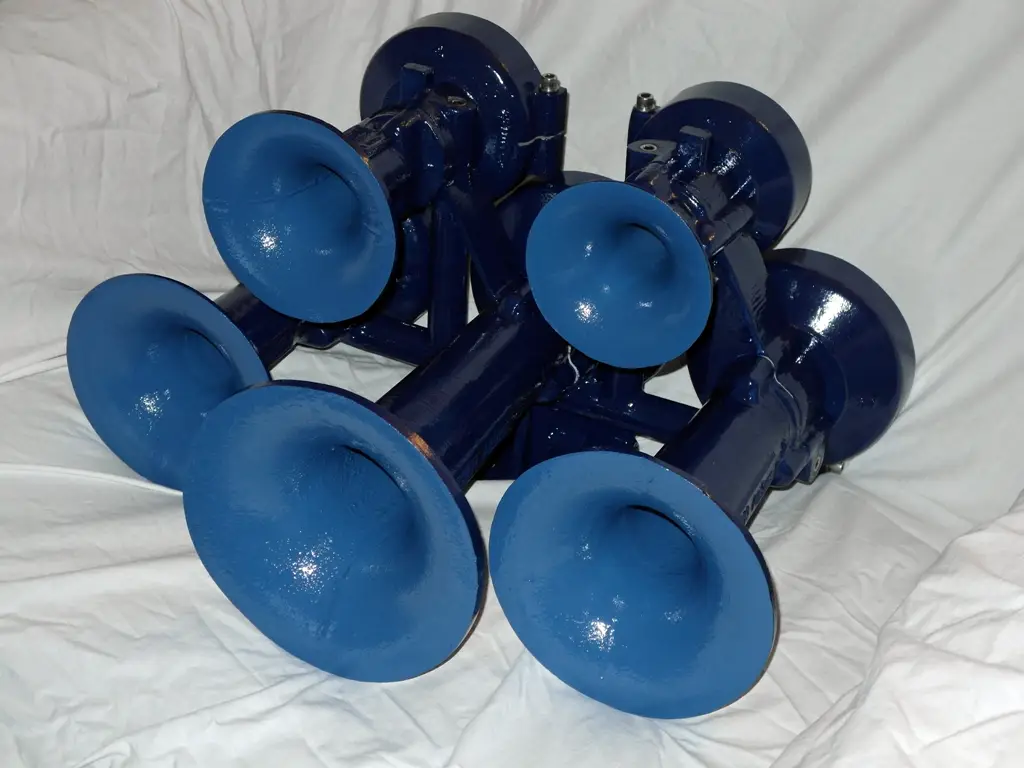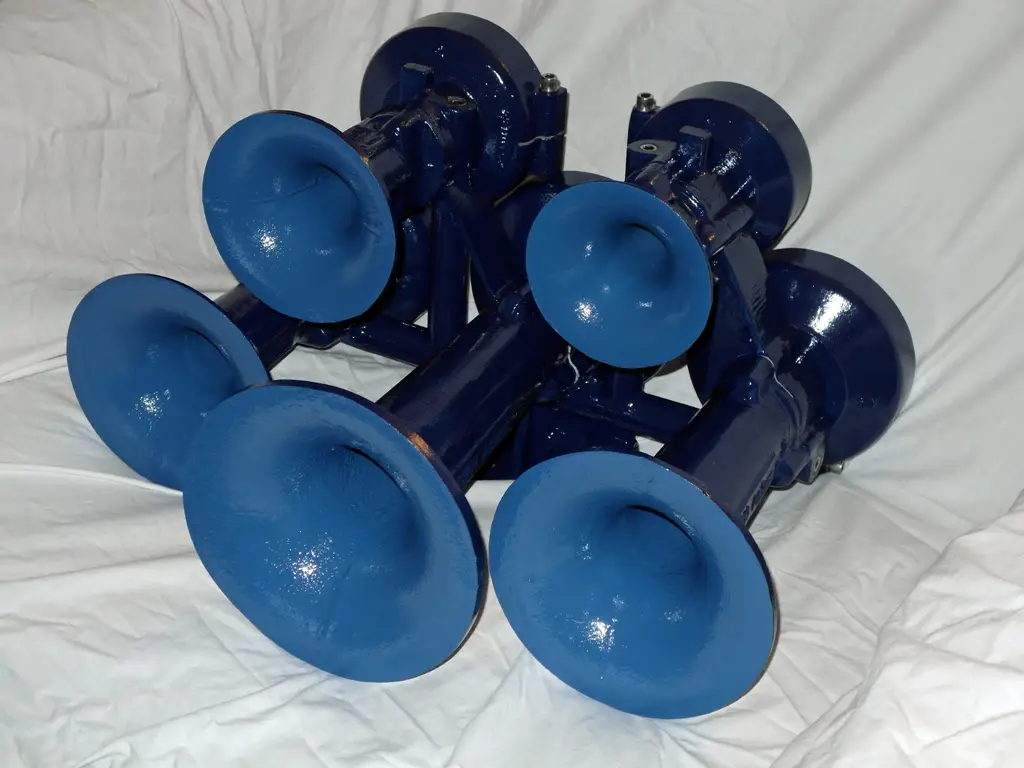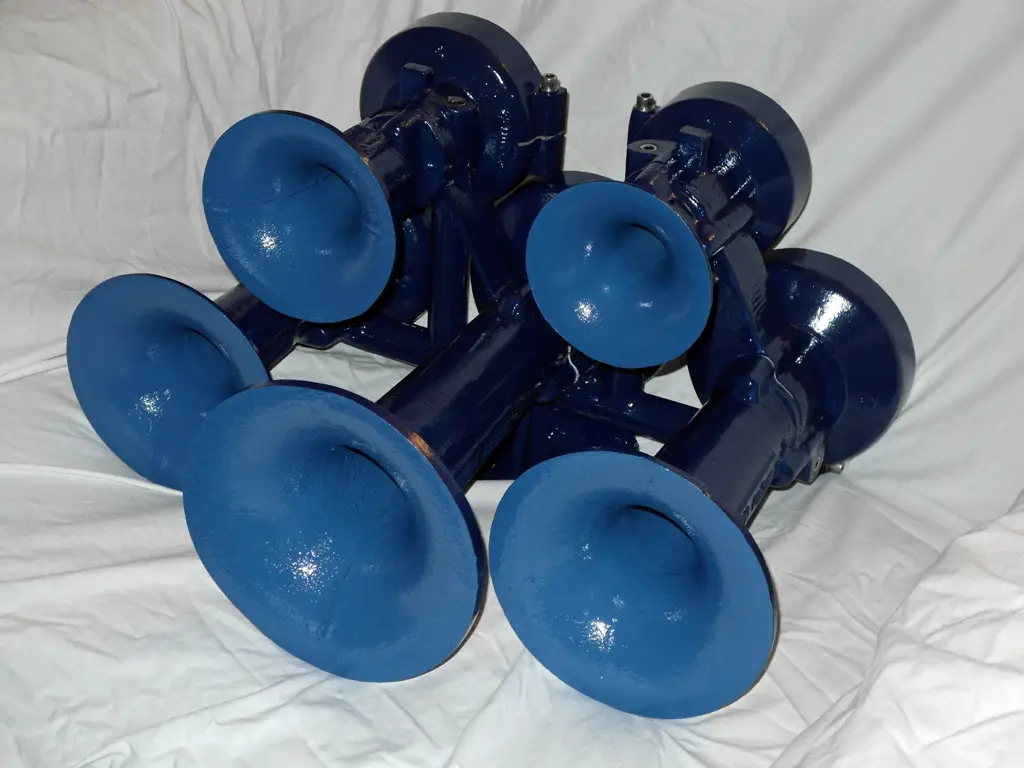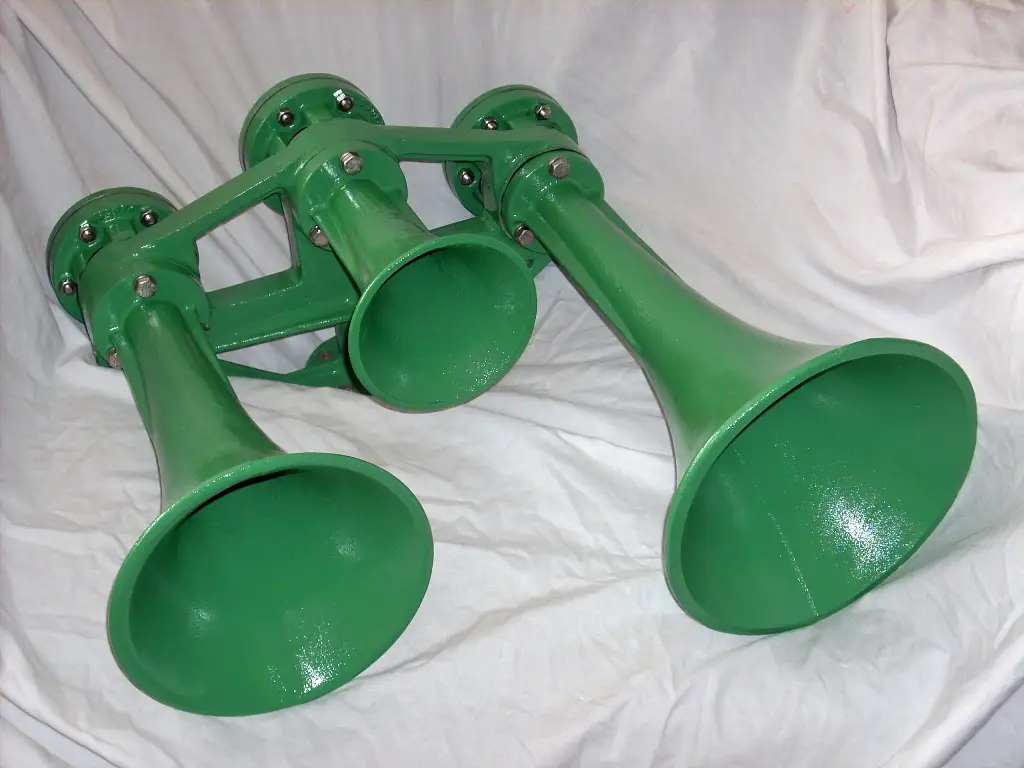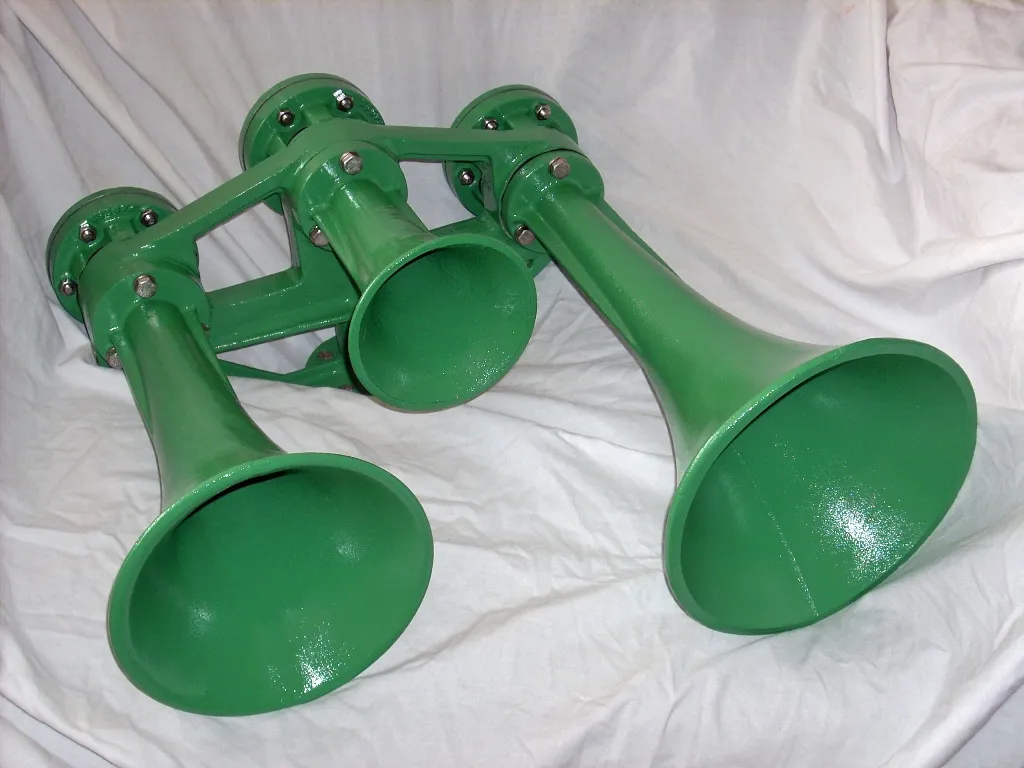
- +All-metal three-bell Outlaw horn on a single mounting bracket
- +150 PSI HornAir 232 system refills 110 to 150 PSI in about 93 seconds
- +Unusually complete published spec sheet — duty cycle, CFM, fill times, dimensions
- +Six-port 2-gallon tank leaves room for tire inflation and air-tool add-ons
- +2-year warranty on air components, with earplugs and a line cutter in the box
- −No model-specific dB rating published for the Outlaw horn
- −At $859.99 it costs notably more than the Outlaw 228H variant
- −Roughly 46 lb of hardware that needs real mounting space
- −4-6 second honk per tank, then a wait for the compressor to recover
- −Horn chord frequencies (Hz) are not disclosed
Methodology
This review aggregates publicly available information from manufacturer specifications, retailer listings, and verified user reviews. We do not perform hands-on testing. Last reviewed: August 9, 2026. Primary sources for this article are HornBlasters’ official Outlaw 232 product pages, the brand’s Outlaw family page, retailer cross-checks for street pricing, and public video demos. Every number below traces back to a URL in the Sources section.
Quick verdict
The HornBlasters Outlaw 232 earns a 4.1/5 from us. It pairs the brand’s three-bell, all-metal Outlaw horn with the HornAir 232 onboard air system — a 150 PSI, 2-gallon setup whose published fill times and duty cycle are unusually well documented for this industry. The catch is price: at $859.99 it sits well above the Outlaw 228H and 127H variants that use the exact same horn, so you are paying mostly for the 3Q compressor and six-port tank. If you want the Outlaw sound with room to grow the air system, this is the variant to get; if you just want the sound, a cheaper sibling kit delivers it. For how this kit compares across the brand’s lineup, see our HornBlasters hub.
What it is
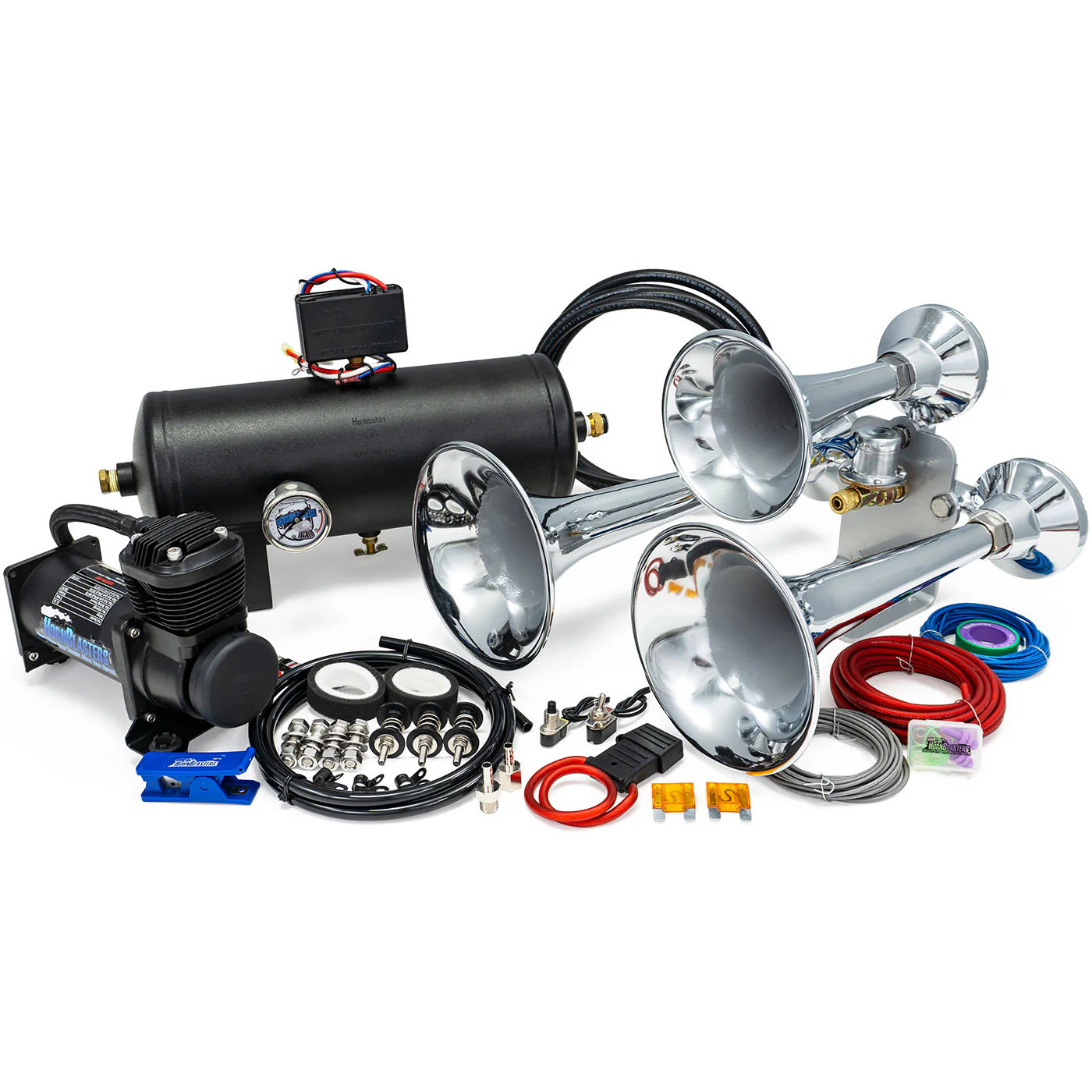
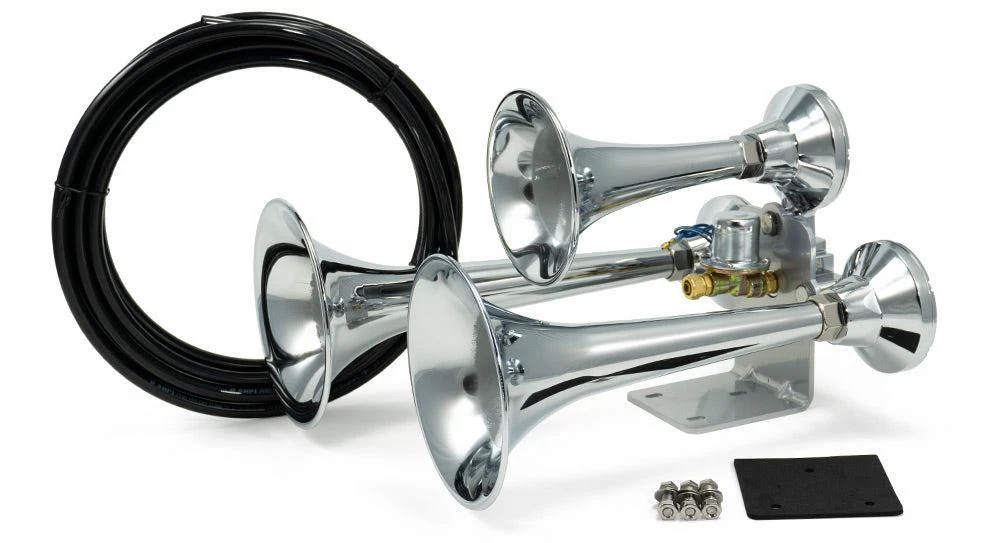
The Outlaw 232 is a complete vehicle train horn kit built around HornBlasters’ Outlaw horn — three wide-flare metal bells mounted on a single metal bracket, available in chrome or stealth black. Per HornBlasters’ product page, the horn assembly measures 18.5” L × 15.5” W × 12.5” H and weighs 15 lb on its own. Some retailers, including Dales Super Store, list the same horn under the “Outlaw 3000” name.
The “232” half of the name refers to the HornAir 232 air system: a 2-gallon, six-port air tank fed by HornBlasters’ 3Q compressor running a 150 PSI working pressure. The whole kit runs on a standard 12-volt DC vehicle electrical system and is aimed at full-size trucks and SUVs — buyers who want an authentic multi-bell train horn chord rather than a compact electric horn. Total kit weight is about 46 lb per the manufacturer’s listing.
Specifications
All figures below come from HornBlasters’ official Outlaw 232 product page unless noted.
| Spec | Value |
|---|---|
| Horn | Outlaw — three wide-flare metal bells on metal bracket (chrome or black) |
| Horn dimensions | 18.5” L × 15.5” W × 12.5” H |
| Horn weight | 15 lb |
| Sound output | Not published — HornBlasters does not advertise a dB figure for this model |
| Air system | HornAir 232, 150 PSI working pressure |
| Compressor | HornBlasters 3Q, 12V DC, 20 A max draw, 1.41 CFM at 0 PSI |
| Compressor dimensions | 10.1” L × 4.5” W × 7” H |
| Duty cycle | 100% at 100 PSI / 50% at 200 PSI |
| Fill time (0–150 PSI) | 3 min 59 sec (± 10 sec) |
| Refill (110–150 PSI) | 1 min 33 sec (± 5 sec) |
| Restart pressure | 110 PSI |
| Tank | 2-gallon, six ports (2× 1/2” NPT, 4× 1/4” NPT), 17” L × 6” dia × 8” H with legs, 10 lb |
| Honk duration | 4–6 seconds per full tank |
| Power | 12-volt DC |
| Total kit weight | ~46 lb |
| Warranty | 1 year on the horn, 2 years on other components (manufacturer’s defect) |
| Price | $859.99 direct; ~$812.99 at Dales Super Store |
Note the missing dB row: HornBlasters publishes a page arguing that most advertised decibel ratings in this market are measured at unrealistic distances and does not print per-model numbers for kits like this one, claiming only that its non-electric horns test at “130 dB or higher” under honest conditions. We treat that as a manufacturer claim, not a measured figure — our decibels guide explains why test distance changes everything.
What’s in the box
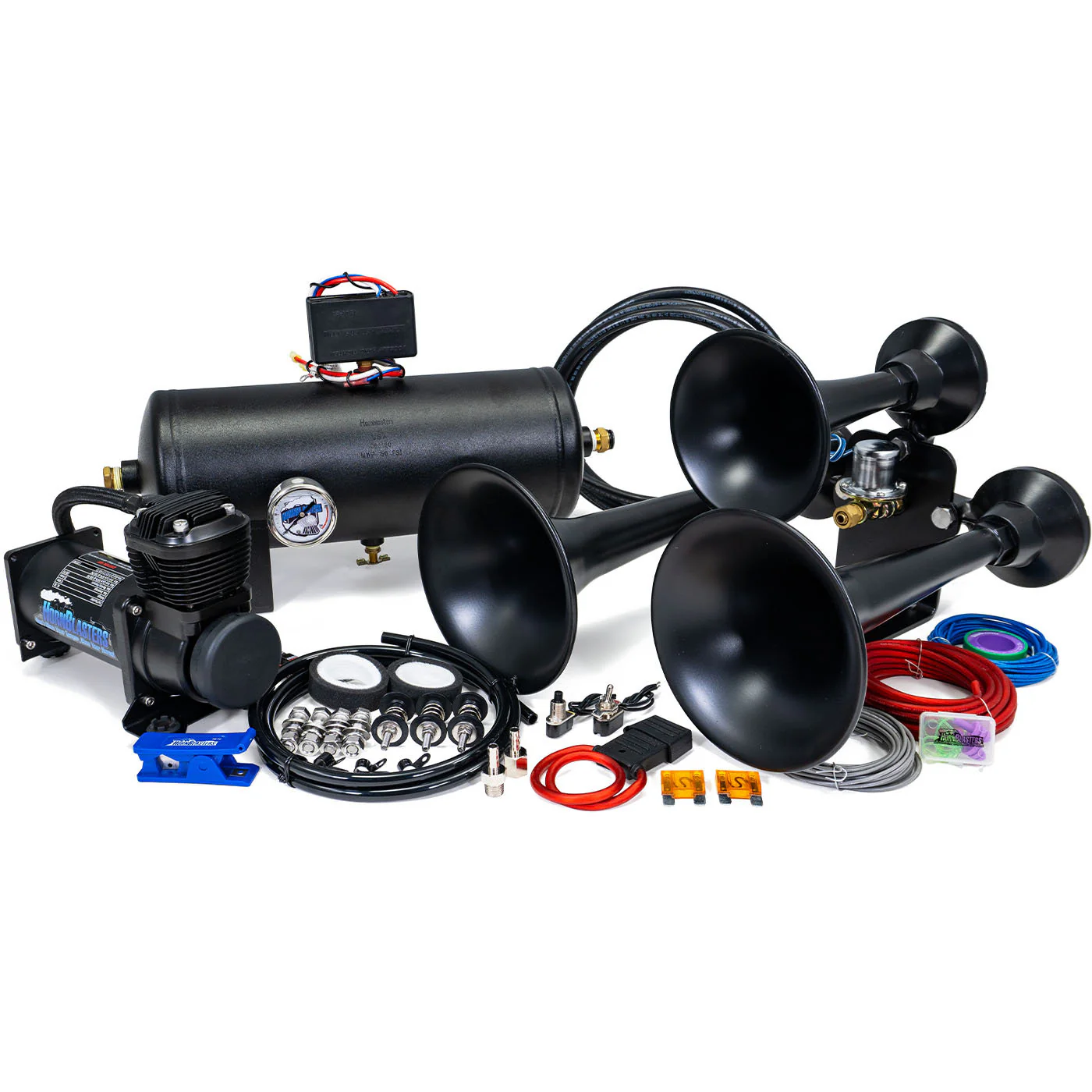
Per the official product page, the kit includes:
- Outlaw three-bell metal train horn (chrome or black) with mounting bracket
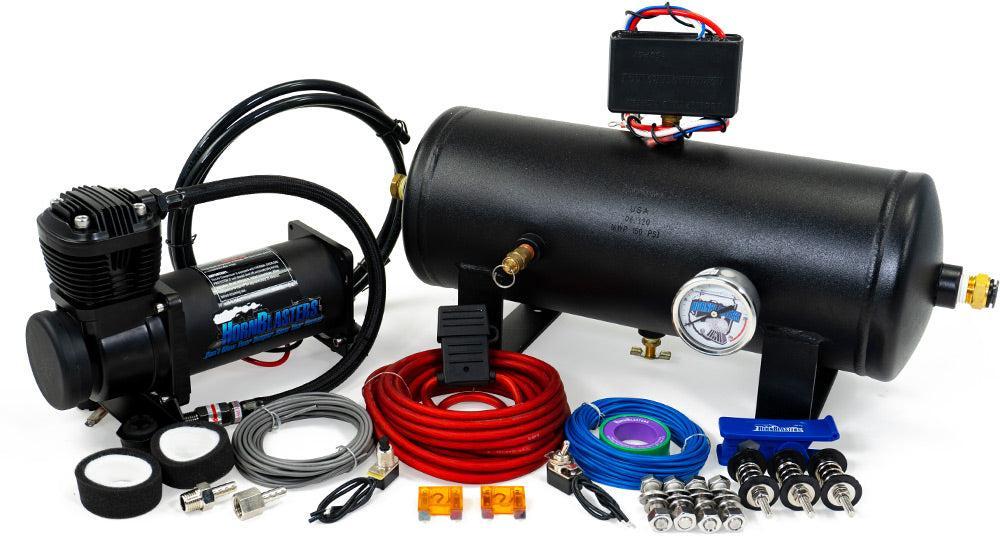
- 2-gallon six-port air tank
- HornBlasters 3Q 12V compressor with intake filter and spare filter elements
- Pressure switch, electric air valve, and pressure gauge
- 10 ft of 1/2” air line and 6 ft of 3/8” air line, plus an air line cutter
- Wiring kit with fuses (red, blue, and grey leads), fitting kit, and mounting hardware
- Instruction manual and a pair of earplugs
Pros
- All-metal horn. Three wide-flare metal bells on a metal bracket — no ABS trumpets at this price point, and the 15 lb horn weight backs that up.
- Documented recovery. The published 110-to-150 PSI refill takes about 93 seconds, and the full 0-to-150 fill just under 4 minutes is documented with tolerances.
- Honest, complete spec sheet. Duty cycle, CFM, amperage, port layout, dimensions, and weights are all published — rare in this market.
- Expansion-ready tank. Six ports (two 1/2” NPT, four 1/4” NPT) leave room for tire inflation, air tools, or a second accessory circuit.
- Sensible warranty and extras. Two years on air components, one year on the horn, plus small touches like the included line cutter and earplugs.
Cons
- No per-model dB number. The brand’s no-fake-dB policy is defensible, but buyers still get no measured loudness figure for this specific horn.
- Premium price. At $859.99 it costs hundreds more than the Outlaw 228H, which uses the same horn with an all-in-one air system.
- Heavy and bulky. Roughly 46 lb across a 17” tank, a 10” compressor, and an 18.5” horn demands real under-bed or frame space.
- Short honk window. Expect 4–6 seconds of full-power honking per tank before pressure drops and the compressor cycles.
- No chord data. Bell frequencies in Hz are not disclosed, so you can’t compare the chord to locomotive horns on paper.
Alternatives
- HornBlasters Outlaw 127H — the same three-bell Outlaw horn on a smaller 1.5-gallon, 120 PSI system at $579.99; an up-to-5-second honk and a lower price for tighter budgets and tighter mounting space. See our Outlaw 127H review.
- HornBlasters Outlaw 228H — same horn, 2-gallon 150 PSI all-in-one air package, listed at $499.99 on sale ($669.99 regular) at review time; the strongest value play in the Outlaw line.
- HornBlasters Rhino 544 — a step up in scale for buyers who want maximum presence rather than the Outlaw’s budget-friendly footprint. See our Rhino 544 review.
For the brand’s classic 2-gallon flagship built around the Shocker-series horns, our Conductor’s Special 228H review covers the other obvious cross-shop.
Install / compatibility notes
The Outlaw 232 is a full onboard-air install, not a plug-and-play horn swap:
- Electrical: 12V DC only, with a 20 A maximum compressor draw — plan a fused, relay-switched feed straight from the battery per the included wiring kit.
- Space: you need room for a 17” × 6” tank (8” tall with legs), the 10.1” compressor, and the 18.5” × 15.5” horn. On pickups, the horn typically goes under the bed or behind the cab; our mounting guide covers the trade-offs.
- Plumbing: the kit ships with 1/2” main line for the horn feed and 3/8” line, matching the valve and tank ports — see our air line sizing guide for why the fat line matters on a three-bell horn.
- Pressure: the system works between the 110 PSI restart point and the 150 PSI cutoff; our PSI guide explains how that range affects sound.
User videos of the kit, including a first-test demo on YouTube, show the expected behavior: a deep multi-bell blast that tapers as tank pressure falls — consistent with the 4–6 second honk rating. General installation steps for kits like this are covered in our step-by-step install guide, and state-by-state usage rules live in our legality section.
Sources
- HornBlasters — Outlaw 232 Chrome Train Horn Kit product page — price ($859.99), 150 PSI system, 110 PSI restart, 3Q compressor specs (duty cycle, fill times, 20 A, 1.41 CFM, dimensions), tank size/ports/dimensions/weight, horn dimensions and weight, honk duration, 12V power, kit weight, warranty, included items
- HornBlasters — Outlaw 232 Black Train Horn Kit product page — black finish variant of the same kit
- HornBlasters — Outlaw Train Horn Kits family page — Outlaw horn description (three wide-flare metal bells, chrome/black) and variant lineup
- HornBlasters — Outlaw Train Horn product page — standalone Outlaw horn dimensions and weight; confirms the same horn ships in the 127H, 228H, and 232 kits
- HornBlasters — Outlaw 127H product page — 127H pricing ($579.99 chrome), 1.5-gallon 120 PSI air system, up-to-5-second honk
- HornBlasters — Outlaw 228H product page — 228H pricing ($499.99 sale / $669.99 regular), 2-gallon 150 PSI single-manifold all-in-one air package
- HornBlasters — Why fake decibel ratings mislead buyers — argument that advertised dB ratings are measured at misleading distances; 3 ft / 100 ft testing claims; “130 dB or higher” blanket statement
- Dales Super Store — HornBlasters HK-C3B-232 Outlaw Chrome 232 listing — street price cross-check ($812.99) and “Outlaw 3000” horn naming
- YouTube — “Hornblasters outlaw 232 first test” — user-posted sound demo of the kit
Train Horn Hub aggregates publicly available data. We do not test products in-house. All trademarks belong to their respective owners.
The Outlaw 232 is the right pick for truck and SUV owners who want an all-metal three-bell train horn with a 150 PSI air system and don't mind paying a premium over the other Outlaw kits for expansion-ready plumbing.
Frequently asked questions
Quick answers to the questions people ask most about this topic.
- How loud is the HornBlasters Outlaw 232 really?
- HornBlasters does not publish a per-model decibel rating for the Outlaw 232 — the company says advertised dB numbers in this market are usually measured at misleading distances, and claims only that its horns test at "130 dB or higher." Treat that as a manufacturer claim; no independent measured figure for this specific horn is published.
- What is the difference between the Outlaw 232, 228H, and 127H?
- All three kits use the same three-bell metal Outlaw horn. The 232 pairs it with the 150 PSI HornAir 232 system (2-gallon six-port tank, 3Q compressor); the 228H uses a 2-gallon 150 PSI all-in-one air package at a lower price; the 127H uses a smaller 1.5-gallon, 120 PSI system with an up-to-5-second honk.
- How long can you honk the Outlaw 232 before the tank runs out?
- HornBlasters rates the kit at 4–6 seconds of honking per full 2-gallon tank. The compressor restarts at 110 PSI and brings the tank back to the full 150 PSI in about 1 minute 33 seconds, per the published spec sheet.
- Is the Outlaw 232 the same as the Outlaw 3000?
- Effectively yes — "Outlaw 3000" is a name some retailers, such as Dales Super Store, use for the three-bell Outlaw horn in their listings. The 232 kit bundles that horn with the HornAir 232 air system.
- What do I need to install the Outlaw 232?
- A 12-volt vehicle with space for the 17-inch tank, 10-inch compressor, and 18.5-inch horn — about 46 lb of hardware in total. The kit includes the wiring kit with fuses, air line, fittings, and mounting hardware; the compressor draws up to 20 amps, so it needs a properly fused battery feed.