Disclaimer. This page summarizes publicly available Vermont statutes as of October 2026. Not legal advice. Verify and consult a licensed Vermont attorney.
- Legal status
- Legal
- Install permitted
- Statute
- §1131
- 23 V.S.A. Chapter 13
- Horn checked
- Yes
- DMV periodic inspection
- Specific dB cap
- None
- Officer-judged
- Siren ban
- Yes
- DMV permit required (§1251)
- Penalty
- Traffic violation
- Civil (§2302)
Are train horns legal in Vermont?
Installing an aftermarket train horn on a private vehicle in Vermont is not prohibited. Vermont train horn law turns on 23 V.S.A. §1131 — “Warning signal.” It tells drivers to sound the horn whenever reasonably necessary for safe operation and not to use it otherwise on a highway. A separate section, 23 V.S.A. §1251, bars driving on a highway with a siren unless the DMV has issued a permit. No Vermont statute names air horns or train horns, and none sets a decibel cap for passenger-vehicle horns.
Install is legal; use on VT public roads — Burlington, Essex, South Burlington, Colchester, Rutland, Montpelier — is the regulated behavior.
What 23 V.S.A. §1131 actually says
The operator of a motor vehicle, whenever reasonably necessary to ensure safe operation, shall give an audible warning with the horn of his or her vehicle but shall not otherwise use the horn when upon a highway.
Operative rules: sound the horn when reasonably necessary for safe operation · don’t use it otherwise on a highway. The section was added in 1971 (No. 258, Adj. Sess., eff. March 1, 1973) and the official history lists no later amendment.
The siren rule sits in §1251(a)(1):
A motor vehicle shall not be operated upon a highway of this State equipped with any of the following: (1) a siren unless either a permit authorizing the siren, issued by the Commissioner of Motor Vehicles, is carried in the vehicle or a permit is not required pursuant to section 1252 of this subchapter;
Updated 2026-10-17: corrected the statute citation and quote. Earlier versions of this page cited “23 V.S.A. §1256 — Warning signals” and quoted text requiring a “suitable and adequate warning signal” and banning “any siren or exhaust whistle.” That text does not appear in the Vermont Statutes: §1256 is the motorcycle headgear law. The horn-use rule is §1131 (quoted above), and the siren rule is §1251, which covers sirens only and does not mention whistles. The page’s status (“legal” to install) is unchanged. Re-verified against the Vermont Legislature’s official Title 23 text on 10/17/2026.
Does the factory horn need to stay working in VT?
Keep it working. Vermont’s statutes don’t spell out a horn-equipment requirement for passenger cars the way many states do. §1221 does require any vehicle on a highway to “be in good mechanical condition” and “properly equipped.” The DMV Periodic Inspection Manual (VN-113) has inspectors check horn function on pleasure cars and light trucks. For motorcycles, it says to reject the vehicle if “the horn is not audible under normal conditions.” §1131 also assumes your vehicle has a horn you can use when safety requires it.
Is a train horn a prohibited device in Vermont?
- ·Siren without a DMV permit (§1251)
- ·Horn use not reasonably necessary for safe operation (§1131)
- ·Permitted emergency vehicles exempt (§1252)
- ·Multi-note air-compressor chord
- ·Not a siren
- ·Install not banned
- ·Use subject to safe-operation rule
Vermont’s equipment ban covers sirens only (§1251). Unlike many states, it has no general “whistle” or “bell” ban. A train horn is a fixed-tone chord horn, not a siren, so the restriction that matters is how you use it under §1131.
Portable and battery-powered train horns in VT
§1131 regulates using “the horn of his or her vehicle” on a highway and doesn’t care about the power source. Expect an officer to apply the same safe-operation test to M18, DeWalt 20V, Ryobi, Makita portables sounded from a vehicle on a public road, and local noise ordinances apply wherever you use them.
Enforcement in practice
Vermont is broadly permissive. Burlington Metro (Chittenden County) sees more complaint-driven enforcement; rural Northeast Kingdom and Green Mountain counties rarely cite.
Practical Vermont train horn compliance
- 01 Keep factory horn wired and working
§1221 requires proper equipment; inspection checks the horn.
- 02 Put the train horn on a separate switch
Distinct from OEM button.
- 03 Use factory horn for ordinary signaling
Safe-operation limit per §1131.
- 04 Never add a siren without a DMV permit
§1251 bars unpermitted sirens on highways.
- 05 Reserve use for off-road / farm / private property
VT has substantial farm and mountain recreation land.
- 06 Watch Burlington / Montpelier ordinances
Municipal noise codes layer on state law.
- 07 Hearing protection when testing
140+ dB causes immediate damage.
How to verify this page
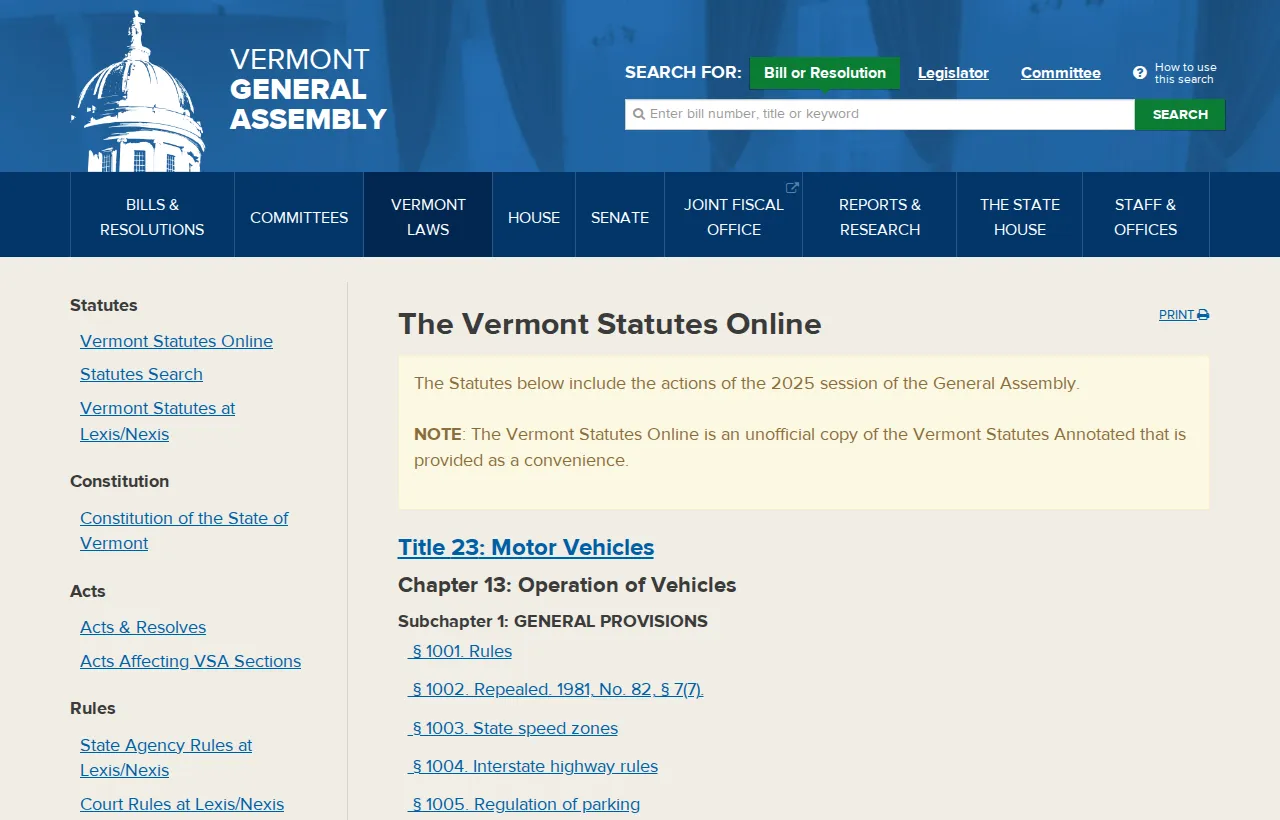
Verify on the Vermont Legislature’s official site: 23 V.S.A. §1131 and 23 V.S.A. §1251. Send a correction if needed.
Nearby states & related laws
All 50 states →New Hampshire
New Hampshire train horn law (RSA 266:54): horn requirement, Manchester / Concord enforcement, aftermarket horn regulations. Plain-English guide.
Massachusetts
Massachusetts train horn law (M.G.L. c.90 §16): horn noise rules, Boston enforcement, aftermarket horn regulations. Plain-English guide with citations.
New York
New York train horn law (NY VTL §375(1)): vehicle horn rules, NYC enforcement, aftermarket horn regulations. Plain-English guide with statute citation.
Maine
Maine train horn law (29-A M.R.S. §1903): signaling device requirements, Portland enforcement, aftermarket horn regulations. Plain-English guide.
Continue on Train Horn
All 50 states
Full state-by-state legality index with statuses, citations, and decibel caps where defined.
Decibel distance calculator
Inverse-square-law tool that shows perceived loudness at any distance from the horn.
Battery-powered platforms
Horns organized by cordless-tool battery — Milwaukee M18, DeWalt 20V, Ryobi, Makita.
HornBlasters Shocker XL review
154 dB four-trumpet flagship kit — measured output, install notes, and verdict.
Sources & Citations
- [1] 23 V.S.A. §1131 — Warning signal (legislature.vermont.gov)
- [2] 23 V.S.A. §1251 — Sirens and emergency warning lamps (legislature.vermont.gov)
- [3] 23 V.S.A. §1221 — Condition of vehicle (legislature.vermont.gov)
- [4] 23 V.S.A. §2302 — Traffic violation defined (legislature.vermont.gov)
- [5] Vermont Legislature — Title 23 Chapter 13 (official portal)
- [6] Vermont DMV — Periodic Inspection Manual (VN-113, 3/2026)
Educational content. Not legal advice. Verify current statutes with your state DMV or a licensed attorney before installation.