Disclaimer. This page summarizes publicly available Missouri statutes as of August 2026 and is published for general informational purposes only. It is not legal advice. Verify the current text and consult a licensed Missouri attorney.
- Legal status
- Legal
- Install permitted
- Statute
- RSMo §307.170
- Title XIX Ch. 307
- Horn required
- Yes
- "Adequate in quantity and volume"
- Specific dB cap
- None
- Unnecessary-noise test
- Other signaling devices
- Banned
- "No other sound-producing signaling device"
- Penalty
- Infraction
- Fine
Are train horns legal in Missouri? Short answer
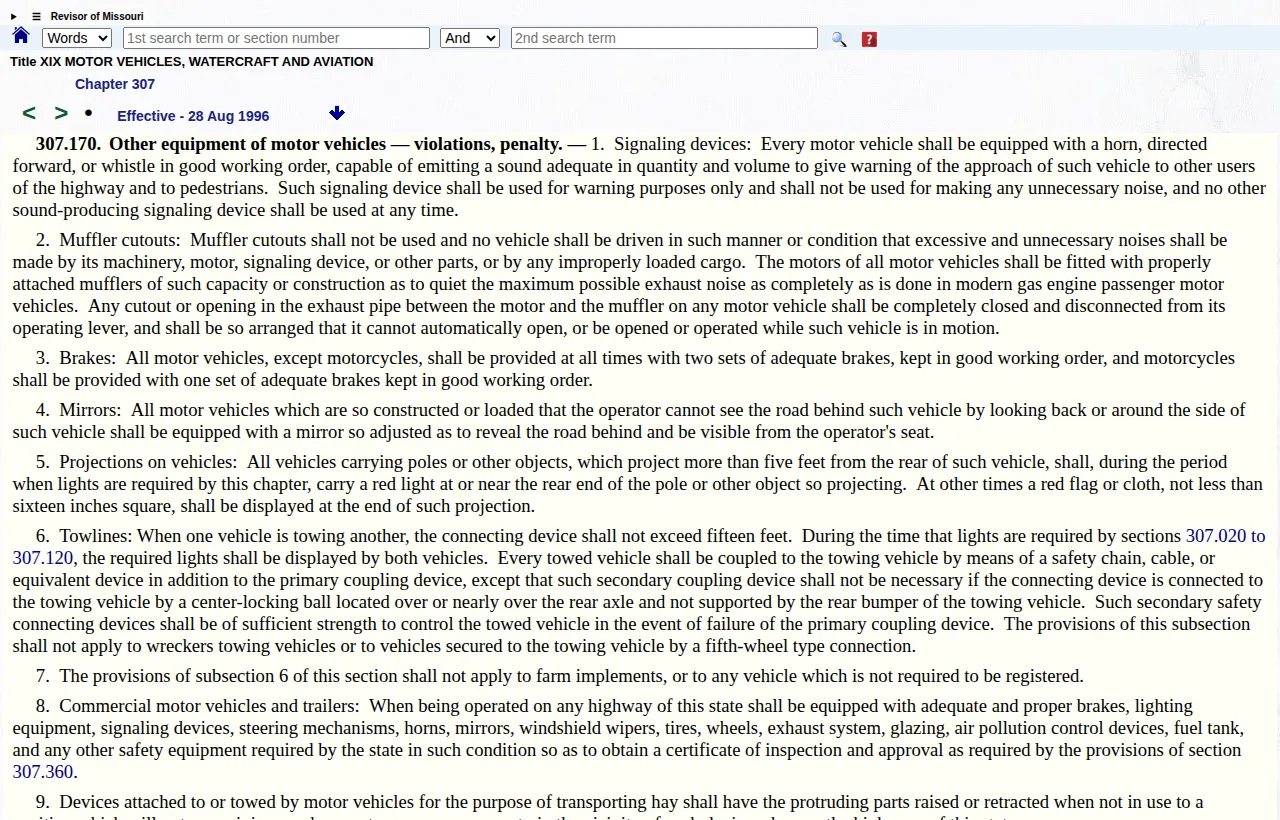
Installing an aftermarket train horn on a private vehicle in Missouri is not prohibited, with a notable caveat. Missouri train horn law is in RSMo §307.170 — “Other equipment of motor vehicles — violations, penalty.” The statute requires every motor vehicle to have a horn (or whistle) “directed forward” that is “adequate in quantity and volume” to warn other road users and pedestrians. Use is restricted to warning purposes only — “no other sound-producing signaling device shall be used at any time.”
That last clause is broader than most UVC states. Install is legal; use of any “sound-producing signaling device” outside of warning purposes is actionable.
What RSMo §307.170 actually says
Every motor vehicle shall be equipped with a horn, directed forward, or whistle in good working order, capable of emitting a sound adequate in quantity and volume to give warning of the approach of such vehicle to other users of the highway and to pedestrians. Such signaling device shall be used for warning purposes only and shall not be used for making any unnecessary noise, and no other sound-producing signaling device shall be used at any time. Violation of this section shall be deemed an infraction.
Operative rules:
- Every motor vehicle must have a horn (or whistle) directed forward, in good working order, adequate for warning.
- Signaling device used for warning only — no “unnecessary noise.”
- No other sound-producing signaling device may be used at any time — this is the Missouri-specific clause.
- Penalty: infraction.
Does the factory horn need to stay working in Missouri?
Yes. §307.170 requires every vehicle to have a working horn directed forward. Disconnecting the OEM horn is an equipment violation.
Is a train horn a prohibited “other sound-producing signaling device”?
This is the Missouri question. The statute allows one horn (or whistle) directed forward, and bars “any other sound-producing signaling device.” Read literally, installing a train horn alongside the factory horn could be read as a prohibited second signaling device.
- ·One horn directed forward
- ·Or one whistle
- ·Must be adequate for warning
- ·Used only for warning purposes
- ·Broader than UVC states
- ·Could apply to second horn installations
- ·Enforcement focuses on USE more than install
- ·Missouri case law is limited on this specific question
The practical read: Missouri courts and officers typically enforce §307.170 through the use provisions — unnecessary-noise and non-warning use — rather than through the “no other signaling device” clause as an installation bar. But the statutory language creates more theoretical risk than in pure UVC states.
Portable and battery-powered train horns in Missouri
§307.170 regulates the signaling device on a motor vehicle without distinguishing power source. Portable horns on Milwaukee M18, DeWalt 20V, Ryobi ONE+, and Makita LXT platforms fall under the same rules — use must be for warning, not novelty.
Enforcement in practice
Missouri is broadly permissive. Kansas City, St. Louis, Springfield, Columbia see more complaint-driven enforcement; rural counties rarely cite.
Practical Missouri train horn compliance
- 01 Keep the factory horn wired, directed forward, and functional
§307.170 requires the horn to be directed forward — this is specific to Missouri.
- 02 Put the train horn on a separate switch
Distinct from the OEM button. Covered or keyed switches help document the train horn as not a primary signaling device.
- 03 Use the factory horn for ordinary signaling only
§307.170 prohibits 'unnecessary noise' and non-warning use.
- 04 Reserve train-horn use for off-road / events / private property
Missouri has substantial rural and farm land. The statute does not reach private-property use.
- 05 Watch KC / St. Louis ordinances
Major cities have municipal noise codes.
- 06 Hearing protection when testing
140+ dB causes immediate damage.
How to verify this page
RSMo sections can be amended. Before acting on anything here, verify the current text of §307.170 on the Missouri Revisor of Statutes’ official portal and consult a licensed Missouri attorney. If you notice this page is out of date, please send a correction.
Nearby states & related laws
All 50 states →Kansas
Kansas train horn law (K.S.A. 8-1738): vehicle horn rules, Wichita enforcement, aftermarket horn regulations. Plain-English guide with statute citations.
Illinois
Illinois train horn law (625 ILCS 5/12-601): vehicle horn rules, Chicago enforcement, aftermarket horn regulations. Plain-English guide with statute citations.
Arkansas
Arkansas Code §27-37-202 covers vehicle horns. Install is not prohibited; unreasonably loud use is citable. Plain-English summary with official sources.
Iowa
Iowa train horn law (Iowa Code §321.432): vehicle horn requirements, Des Moines enforcement, aftermarket horn regulations. Plain-English guide.
Continue on Train Horn
All 50 states
Full state-by-state legality index with statuses, citations, and decibel caps where defined.
Decibel distance calculator
Inverse-square-law tool that shows perceived loudness at any distance from the horn.
Battery-powered platforms
Horns organized by cordless-tool battery — Milwaukee M18, DeWalt 20V, Ryobi, Makita.
HornBlasters Shocker XL review
154 dB four-trumpet flagship kit — measured output, install notes, and verdict.
Sources & Citations
- [1] Missouri Revisor of Statutes — §307.170 (official portal)
- [2] RSMo Chapter 307 — Vehicle Equipment Regulations
- [3] Missouri Revised Statutes §307.170 — Other equipment of motor vehicles (FindLaw)
Educational content. Not legal advice. Verify current statutes with your state DMV or a licensed attorney before installation.