Disclaimer. This page summarizes publicly available Delaware statutes as of July 2026 and is published for general informational purposes only. It is not legal advice, and nothing on this page creates an attorney–client relationship. Statutes change, enforcement varies by jurisdiction, and individual circumstances matter — always verify the current text and consult a licensed Delaware attorney before making installation or use decisions that may carry legal consequences.
- Legal status
- Legal
- Install permitted
- Statute
- §4306
- 21 Del. C. Title 21
- Audibility required
- 200 ft
- Factory horn minimum
- Specific dB cap
- None
- "Unreasonably loud" test
- Siren ban?
- Yes
- Emergency vehicles exempt
- Penalty
- Traffic violation
- Civil fine
Short answer
Installing a train horn on a private vehicle in Delaware is not prohibited. 21 Del. C. §4306(a) requires every motor vehicle on a highway to have a horn audible at 200 feet. §4306(b) then limits horn use to audible warnings given “when reasonably necessary to insure safe operation” — and specifically prohibits using a horn to make an “unreasonably loud or harsh sound,” using it while stationary, or honking at animal-drawn vehicles and bicycles when there’s no danger of collision.
Delaware’s use rules are stricter than the Uniform Vehicle Code default many states follow: the horn may not be used “for any other purpose” than a safety warning, and blasting it while parked is itself a listed violation. Install is fine; public-road use outside a genuine safety warning can be cited.
Updated 2026-07-11: replaced an incorrect statutory quote. An earlier version of this page quoted Uniform Vehicle Code horn language (“reasonable warning … unnecessary or unreasonable loud or harsh sound”) that does not appear in Delaware’s statute. The verbatim §4306(a)–(b) text now shown below was verified against the official Delaware Code Online portal. The bottom line — install permitted, use restricted — is unchanged, but Delaware’s actual use rules are more specific than previously described.
What the statute actually says
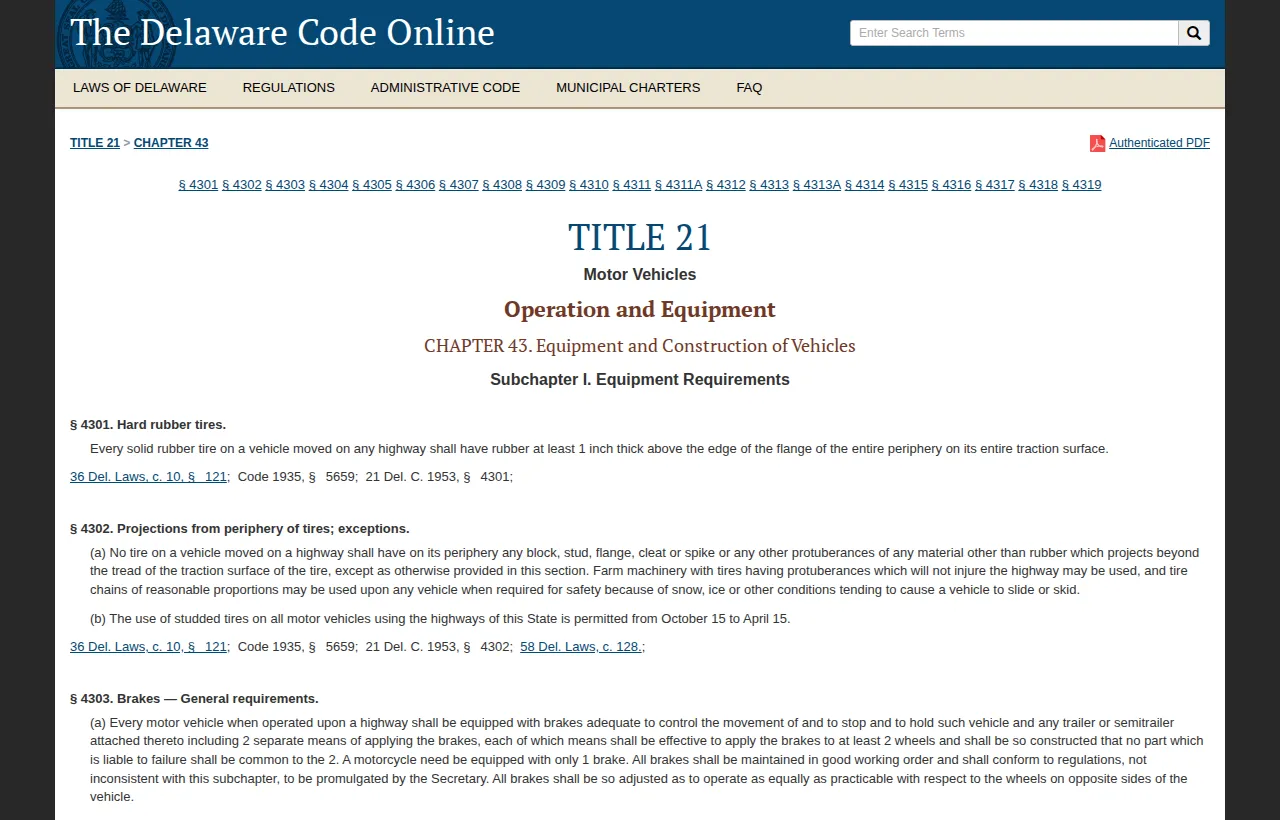
(a) Every motor vehicle when operated upon a highway shall be equipped with a horn in good working order capable of emitting sound audible under normal conditions from a distance of not less than 200 feet. (b) Except as otherwise provided, no vehicle shall be equipped with and no person shall use upon a vehicle any siren, exhaust, compression or spark plug whistle. The driver of a vehicle shall, when reasonably necessary to insure safe operation, give audible warning with the horn but shall not otherwise use the horn for any other purpose. No driver of any vehicle shall use a horn: (1) To make unreasonably loud or harsh sound; (2) When stationary; or (3) When passing an animal-drawn vehicle or bicycle under normal conditions where no imminent danger of a collision exists.
Operative rules:
- Every motor vehicle on a highway must have a horn audible at 200 feet (§4306(a)).
- Horn use is limited to safety warnings — “when reasonably necessary to insure safe operation,” and “not otherwise … for any other purpose” (§4306(b)).
- No “unreasonably loud or harsh sound” from the horn (§4306(b)(1)).
- No horn use while the vehicle is stationary (§4306(b)(2)) — this catches parking-lot and driveway demos.
- §4306(b) itself bans sirens and exhaust, compression, or spark-plug whistles on non-emergency vehicles; §4307 reserves warning devices like bells and sirens for emergency vehicles.
No specific decibel cap — loudness is officer-judged against the “unreasonably loud or harsh” standard.
Does the original factory horn need to stay operational?
Yes. The 200-ft audibility requirement is an equipment rule on the vehicle itself. The factory horn must be installed and functional regardless of any additional horns. Disconnecting it to rely on a train-horn-only setup is an equipment violation under §4306.
Keep the factory horn wired; put the train horn on a separate, dedicated switch.
Is a train horn prohibited under §4306?
Delaware’s statute doesn’t specifically address multi-trumpet train horns. §4306(b)‘s equipment ban covers sirens and exhaust, compression, or spark-plug whistles — categories that don’t describe an air horn — and its use rules regulate how any horn is sounded, not which horn types may be installed.
- ·Equipping or using a siren, exhaust, compression or spark-plug whistle
- ·Using the horn for any purpose other than a safety warning
- ·Making unreasonably loud or harsh sound
- ·Using the horn while stationary
- ·Installing an additional horn alongside the factory one
- ·Audible warning when reasonably necessary for safe operation
- ·Factory horn must remain audible at 200 ft
- ·No dB cap specified
Portable / battery-powered train horns
§4306(b)‘s use rules apply to any horn “upon a vehicle” without distinguishing power source. Portable train horns on Milwaukee M18, DeWalt 20V, Ryobi ONE+, and Makita LXT platforms are treated like any other horn:
- Not prohibited to install or carry.
- Subject to the same use rules on a public highway — safety warnings only, no “unreasonably loud or harsh sound,” and no sounding while stationary.
- Cannot replace the factory horn for 200-ft audibility compliance.
Enforcement in practice
Delaware is broadly permissive for aftermarket audio equipment. State Police and municipal enforcement tend to act on complaints rather than proactive inspection. Wilmington, Dover, and Newark areas see more complaint-driven citations; rural Sussex and Kent County areas rarely enforce equipment installation alone.
Common citation triggers:
- Horn use in residential areas, especially at night
- Complaint from pedestrians or neighbors
- Horn paired with reckless-driving facts
Practical compliance
- 01 Keep the factory horn wired and functional
The 200-ft audibility requirement applies to the vehicle regardless of what else is installed.
- 02 Put the train horn on a separate switch
Clearly distinct from the OEM button. Covered or keyed switches add install discipline.
- 03 Use the factory horn for ordinary traffic signaling
§4306(b) allows horn use only when 'reasonably necessary to insure safe operation.' A novelty chord doesn't fit that test.
- 04 Never sound it while parked or stationary
§4306(b)(2) makes horn use 'when stationary' a listed violation — parking-lot demos are the easiest ticket to write.
- 05 Reserve use for off-road / events / private property
Farm use, trails, closed courses, event vehicles — the practical pattern in Delaware.
- 06 Watch local ordinances
Wilmington and Newark have separate noise codes. Residential use near city limits can trigger municipal citations.
- 07 Hearing protection when testing
140+ dB causes immediate damage at close range. Use our calculator to plan realistic distances.
Use our decibel distance calculator to see how loud your horn will be at bystander distance.
How to verify this page
Delaware Code sections can change. Before acting on anything here, verify the current text of §4306 on the official Delaware Code Online portal and consult a licensed Delaware attorney for your specific situation. If you notice this page is out of date, please send a correction — we update within 48 hours when a cited source is provided.
Nearby states & related laws
All 50 states →Maryland
Maryland train horn law (Md. Transp. §22-401): vehicle horn rules, Baltimore / DC metro enforcement, aftermarket horn regulations. Plain-English guide.
Pennsylvania
Pennsylvania train horn law (75 Pa.C.S. §4535): vehicle horn rules, Philadelphia / Pittsburgh enforcement, aftermarket horn regulations. Plain-English guide.
New Jersey
New Jersey train horn law (N.J.S.A. 39:3-69): vehicle horn rules, active NJ enforcement, aftermarket horn regulations. Plain-English guide.
Virginia
Virginia train horn law (Va. Code §46.2-1060): vehicle horn rules, Virginia Beach / Richmond enforcement, aftermarket horn regulations. Plain-English guide.
Continue on Train Horn
All 50 states
Full state-by-state legality index with statuses, citations, and decibel caps where defined.
Decibel distance calculator
Inverse-square-law tool that shows perceived loudness at any distance from the horn.
Battery-powered platforms
Horns organized by cordless-tool battery — Milwaukee M18, DeWalt 20V, Ryobi, Makita.
HornBlasters Shocker XL review
154 dB four-trumpet flagship kit — measured output, install notes, and verdict.
Sources & Citations
- [1] Delaware Code Online — Title 21 §4306 (official state portal)
- [2] Delaware DMV — Rules and Regulations
- [3] 21 Del. C. §4306 — Horns and other sound devices; unlawful use (Justia, 2024 code)
Educational content. Not legal advice. Verify current statutes with your state DMV or a licensed attorney before installation.