Disclaimer. This page summarizes publicly available Connecticut statutes as of July 2026 and is published for general informational purposes only. It is not legal advice, and nothing on this page creates an attorney–client relationship. Statutes change, enforcement is active in Connecticut, and individual circumstances matter — always verify the current text and consult a licensed Connecticut attorney before making installation or use decisions that may carry legal consequences.
- Legal status
- Mounted only
- Install tolerated, use restricted
- Statute
- §14-80 + §14-80a
- C.G.S. Title 14
- Audibility required
- 200 ft
- Factory horn minimum
- Specific dB cap
- Yes
- Per §14-80a regulations
- Siren/whistle ban?
- Yes
- Emergency vehicles exempt
- Penalty
- Infraction
- Civil fine · state enforcement
Short answer
Connecticut is a “mounted-only” jurisdiction in practice. C.G.S. §14-80 requires every motor vehicle to carry a horn audible at 200 feet, bans any horn from emitting “an unreasonably loud or harsh sound or a whistle,” and prohibits sirens/whistles/bells outside of emergency vehicles. A separate statute, §14-80a, gives the DMV rulemaking authority to set maximum decibel noise levels for motor vehicles — which is why Connecticut’s regulatory reach goes further than a plain UVC state.
Installation of a train horn is not expressly prohibited; actual use on a public Connecticut highway is tightly restricted by the noise-cap regulations plus the “unreasonably loud” standard. Most Connecticut train horn owners keep their install for private property, off-road, or events.
What the statutes actually say
Every motor vehicle shall, when operated on a highway, be equipped with a horn in good working order and capable of emitting sound audible under normal conditions from a distance of not less than two hundred feet, but no horn or other warning device shall emit an unreasonably loud or harsh sound or a whistle.
And paired with the siren / whistle / bell prohibition in §14-80(f):
No vehicle shall be equipped with, nor shall any person use on a vehicle, any siren, whistle or bell as a warning signal device, except as otherwise permitted by this section. […] Any authorized emergency vehicle may be equipped with a siren, whistle or bell, capable of emitting sound audible under normal conditions from a distance of not less than five hundred feet and of a type approved by the Department of Motor Vehicles.
Operative rules:
- Every motor vehicle on a highway must have a horn audible at 200 feet.
- No horn may emit “an unreasonably loud or harsh sound or a whistle.”
- Sirens, whistles, and bells are prohibited on non-emergency vehicles.
- §14-80a delegates rulemaking to DMV for maximum decibel levels of motor-vehicle noise — which includes horn output.
Does the original factory horn need to stay operational?
Yes. §14-80(e) applies to the vehicle’s equipment regardless of any additional horns installed. Disconnecting the factory horn is an equipment violation even if a train horn is wired and functional. Connecticut State Police and municipal officers have active practice of checking factory horn function during traffic stops.
Standard compliance pattern: factory horn wired to the OEM button; train horn on a separate switch, ideally covered or keyed.
Is a train horn a “whistle” or “siren” under §14-80?
§14-80(f) prohibits sirens, whistles, and bells on non-emergency vehicles. Connecticut’s term “whistle” follows UVC usage and refers to single-tone pressure devices.
- ·Siren — continuous variable-pitch tone
- ·Whistle — single-tone pressure device
- ·Bell — fire / warning bell
- ·All prohibited on non-emergency vehicles
- ·Emergency vehicles: DMV-approved, audible at 500 ft
- ·Multi-note chord, not a single whistle tone
- ·Not a siren — no variable-pitch sweep
- ·Install itself is not banned by §14-80
- ·BUT subject to §14-80a dB caps and "unreasonably loud" test
Portable / battery-powered train horns
§14-80 and §14-80a apply to any motor-vehicle-mounted warning device regardless of power source. Portable train horns on Milwaukee M18, DeWalt 20V, Ryobi ONE+, and Makita LXT platforms fall under the same rules:
- Not prohibited to install.
- Subject to the “unreasonably loud or harsh” test and §14-80a noise caps if used on a public highway.
- Cannot replace the factory horn for 200-ft audibility compliance.
Connecticut’s density means portable use on public roads is more likely to trigger a complaint than in lower-population states.
Enforcement in practice
Connecticut is an actively-enforcing state. Troop I-90 and municipal departments in Hartford, New Haven, Stamford, Bridgeport, and Waterbury regularly cite noise-equipment violations. Common triggers:
- Horn use in any populated area
- Complaint-driven stops
- Horn paired with exhaust / lighting modifications
- Connecticut State Police noise-enforcement details on highways
Unlike Alabama or Arkansas, install alone can be inspected and questioned during routine stops, especially on modified trucks or vehicles with visible aftermarket audio equipment.
Practical compliance
- 01 Keep the factory horn wired and functional
Non-negotiable. CT State Police actively inspect OEM horn function during modified-vehicle stops.
- 02 Use a covered or keyed switch
Makes the train horn clearly not a primary warning device, which aligns with §14-80's limitation on signal equipment.
- 03 Do not use on public roads in populated areas
Hartford, New Haven, Stamford, Bridgeport, Waterbury — all have active noise enforcement. Use is what gets cited.
- 04 Reserve use for off-road / events / private property
This is the practical 'mounted-only' pattern — keep the install for off-highway, closed courses, motorsports, or private property.
- 05 Understand §14-80a noise caps
Connecticut DMV can set and enforce maximum dB caps for motor vehicles. This is a distinct risk vector beyond the §14-80 'unreasonably loud' test.
- 06 Hearing protection when testing
140+ dB causes immediate damage at close range. Use our calculator to plan real exposure distances.
Our decibel distance calculator shows how loudness drops off with range — critical in a state with active noise enforcement.
How to verify this page
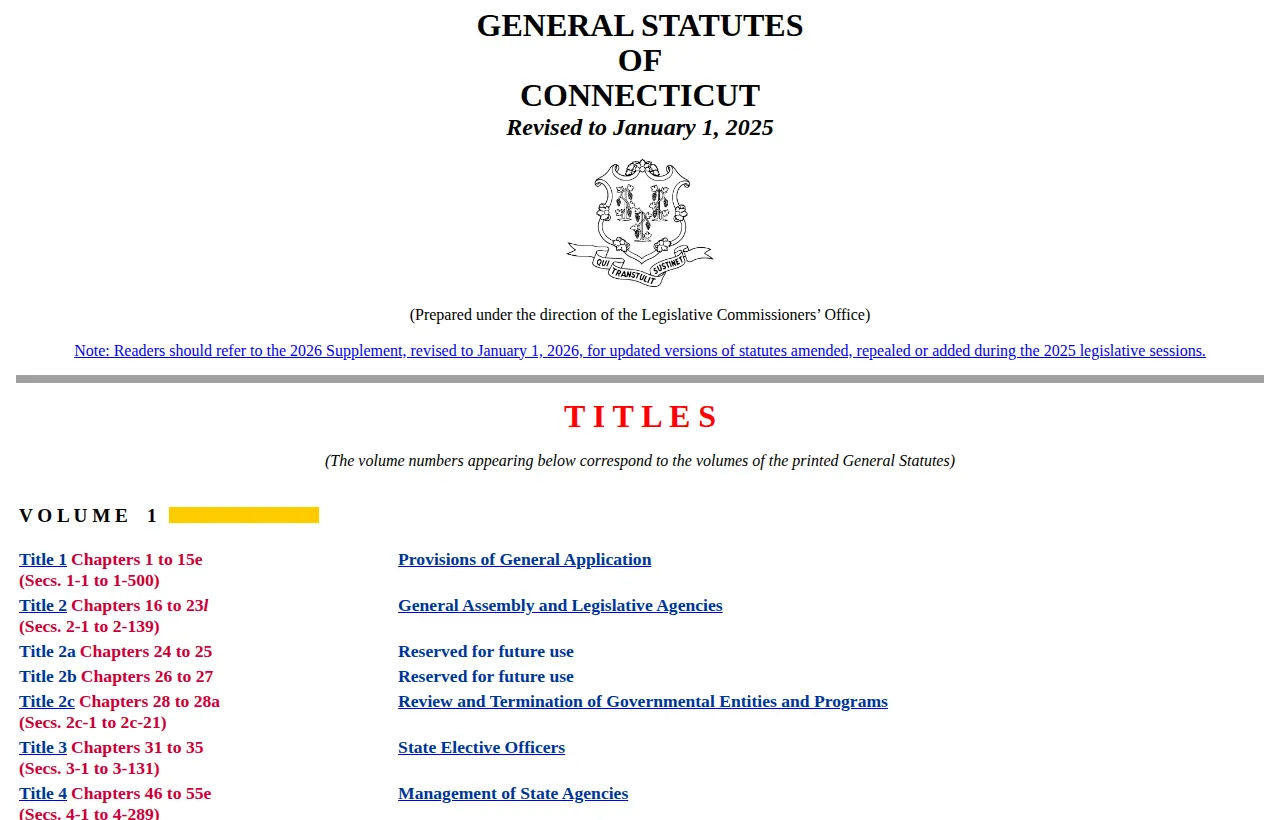
C.G.S. sections and DMV regulations can change. Before acting on anything here, verify the current text of §14-80 and §14-80a on the Connecticut General Assembly’s official General Statutes portal and consult a licensed Connecticut attorney for your specific situation. If you notice this page is out of date, please send a correction — we update within 48 hours when a cited source is provided.
Nearby states & related laws
All 50 states →New York
New York train horn law (NY VTL §375(1)): vehicle horn rules, NYC enforcement, aftermarket horn regulations. Plain-English guide with statute citation.
New Jersey
New Jersey train horn law (N.J.S.A. 39:3-69): vehicle horn rules, active NJ enforcement, aftermarket horn regulations. Plain-English guide.
Massachusetts
Massachusetts train horn law (M.G.L. c.90 §16): horn noise rules, Boston enforcement, aftermarket horn regulations. Plain-English guide with citations.
Rhode Island
Rhode Island train horn law (R.I. Gen. Laws §31-23-8): vehicle horn rules, Providence / Warwick enforcement, aftermarket horn regulations. Plain-English guide.
Continue on Train Horn
All 50 states
Full state-by-state legality index with statuses, citations, and decibel caps where defined.
Decibel distance calculator
Inverse-square-law tool that shows perceived loudness at any distance from the horn.
Battery-powered platforms
Horns organized by cordless-tool battery — Milwaukee M18, DeWalt 20V, Ryobi, Makita.
HornBlasters Shocker XL review
154 dB four-trumpet flagship kit — measured output, install notes, and verdict.
Sources & Citations
- [1] Connecticut General Assembly — General Statutes, Chapter 246 (official)
- [2] Connecticut DMV — Motor Vehicle Laws Reference
- [3] C.G.S. §14-80 — Mechanical equipment (FindLaw secondary)
- [4] C.G.S. §14-80a — Maximum noise levels (FindLaw secondary)
Educational content. Not legal advice. Verify current statutes with your state DMV or a licensed attorney before installation.