Duty Cycle (Compressor) — Train Horn Glossary
Duty cycle for train horn compressors — ratio of ON time to total time, why 33% at 100 PSI is typical, what 100% duty XD-844K dual-compressor means, thermal limits.
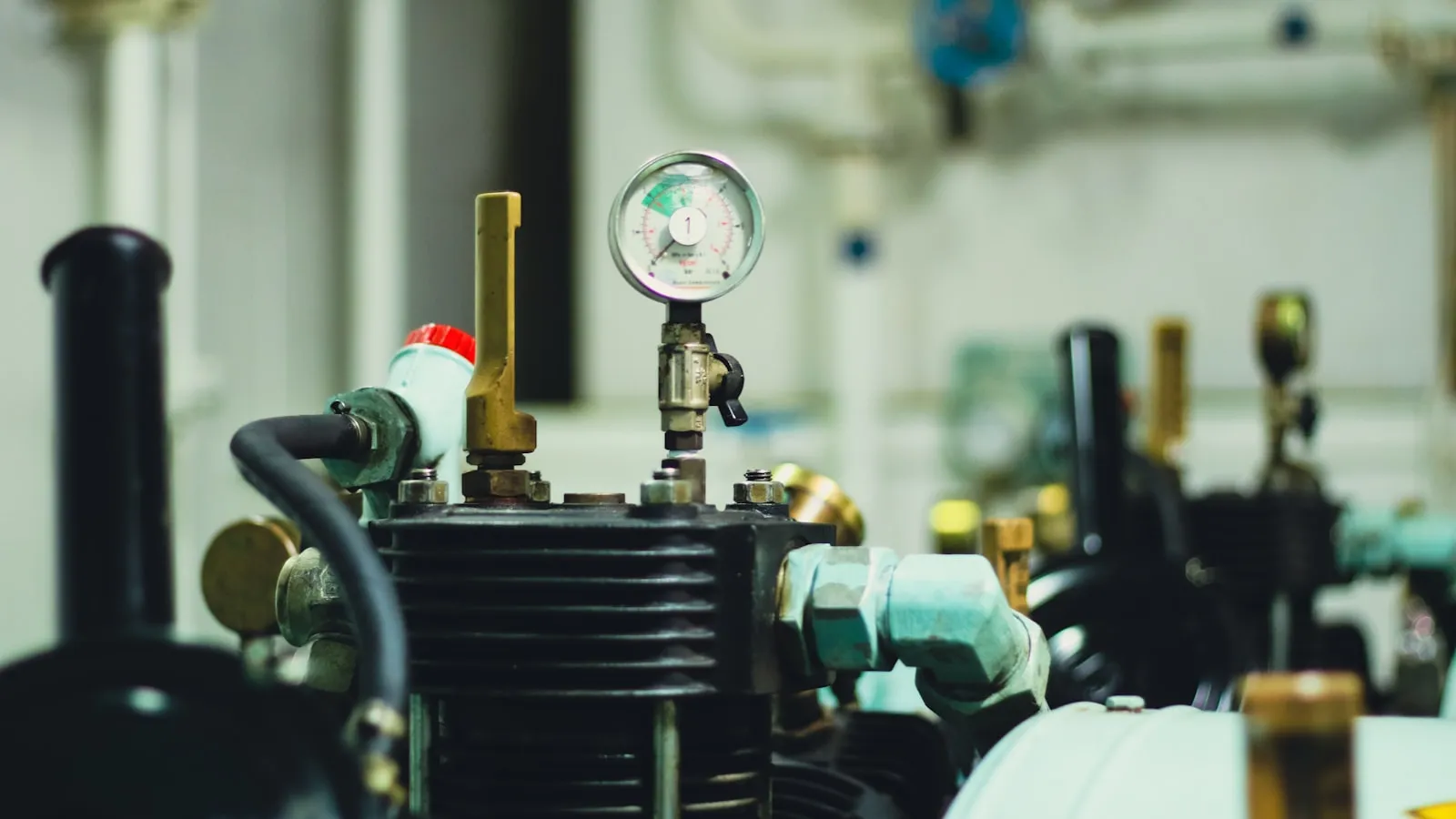
Duty cycle is the ratio of a compressor’s allowed ON time to its total operating time, expressed as a percentage. A compressor rated for 33% duty cycle at 100 PSI can run 33% of the time and must be off for the other 67% to dissipate heat — for example, run 5 minutes, off 10 minutes. Train horn compressors are typically rated 33–50% duty cycle on single-compressor kits and 100% on dual-compressor configurations like the HornBlasters XD-844K.
- Single compressor (1NM)
- 33% at 100 PSI
- Per HornBlasters HD-544K spec
- Dual compressor (2× 1NM)
- 100% at 100 PSI
- Per HornBlasters XD-844K spec
- Higher PSI = lower duty
- Yes, inverse relationship
- More heat at higher pressure
- Heat-related limit
- Coil insulation
- Failure mode at exceeded duty
- Typical 5-gal refill
- ~6:45 from 0 PSI
- Within duty cycle window
- Continuous-duty rating
- XD-844K dual
- Two compressors split the load
What duty cycle means
A 12 V air compressor’s motor and head get hot when running. Duty cycle is the manufacturer’s specification of how much running time the compressor can sustain before it overheats and needs cooling time. The duty cycle is typically given as:
- A percentage (33%, 50%, 100%) at a specified back-pressure
- Sometimes as a time ratio (“5 minutes on / 10 minutes off”)
Both express the same concept: 33% duty = compressor allowed to be ON for one-third of any given time window.
Why duty cycle matters for train horns
If you exceed the rated duty cycle, the compressor overheats. Common consequences:
- Thermal cutoff trips. Most modern compressors include an internal thermal switch that turns off the motor at ~185 °F. The compressor stops until it cools down (typically 10–20 minutes).
- Insulation breakdown. Repeated overheating degrades the motor’s enamel-coated copper windings. Result: shortened compressor life, eventual motor failure.
- Tank doesn’t refill. With the compressor in thermal cutoff, the tank can’t refill between blasts. You have a one-blast-only system until cooling.
For train horns: typical use (a few honks at a tailgate, occasional grade-crossing sounds at a stadium) is well within the 33% duty rating of a single 1NM-class compressor. Heavy use (sustained blasting at an event for hours) needs the 100% duty XD-844K configuration with dual compressors.
HornBlasters published duty cycle specs
Per the HornBlasters Conductor’s Special 228H product page and Shocker XL kit specs:
| Kit | Compressor | Duty cycle |
|---|---|---|
| Conductor’s Special 228H | Single 228H | Standard 33% at 100 PSI |
| Shocker XL HD-544K | Single 1NM | 33% at 100 PSI |
| Shocker XL XD-844K | Dual 1NM | 100% at 100 PSI / 50% at 200 PSI |
| Nathan K5LA HD-544K | Single 1NM | 33% at 100 PSI |
| Nathan K5LA XD-844K | Dual 1NM | 100% at 100 PSI |
The XD-844K’s “100% at 100 PSI” rating means it can run continuously without thermal cutoff at the standard tank cut-out pressure. This matters for use cases like:
- Stadium installs that fire the horn dozens of times during a game
- Marine use where multiple boats are signaled in succession
- Heavy-duty truck installs where the system might cycle frequently in highway driving
For most consumer use, the single-compressor 33% duty kit is plenty.
Why higher PSI lowers duty cycle
A 12 V compressor draws more current and produces more heat as back-pressure rises. At low PSI (10–20 PSI typical for tire inflation), most automotive compressors run continuously without overheating. At 150 PSI (train horn cut-out), the same compressor heats much faster because:
- Each compression cycle does more work against higher back-pressure
- More current draws → more I²R heating in the motor windings
- Less airflow means less convective cooling of the head
That’s why specs typically include the PSI: “33% at 100 PSI” means duty drops if you operate at higher pressure. The XD-844K’s “50% at 200 PSI” rating is half its 100 PSI rating because the higher back-pressure effectively halves the cooling time.
What “100% duty” actually means
A “100% duty cycle” rating doesn’t mean the compressor will run forever without failing — it means it can run continuously while maintaining the rated back-pressure, with the manufacturer’s thermal management (cooling fans, head design, motor sizing) sufficient to dissipate heat at the rated load.
In practice, a “100% duty” compressor will still cycle off via the pressure switch (110 PSI cut-in, 150 PSI cut-out) — it doesn’t run continuously in normal operation because the tank is full most of the time. The 100% rating just means it could theoretically run nonstop without overheating.
Calculating fill time within duty cycle
Use the compressor recovery calculator to model:
- Tank fill time from 0 → cut-out PSI on a single compressor (typical: 6:45 for 5-gallon tank, 1NM compressor, 0 → 150 PSI)
- Tank refill time within a cycle (typical: 55 sec from 110 → 145 PSI)
- Duty-adjusted continuous use — how long you can repeatedly fire the horn before the compressor needs a cooldown break
Related glossary entries
- PSI — the pressure the compressor maintains; higher PSI = lower duty cycle
- Solenoid Valve — fires after the compressor builds pressure
- Decibel — the output that depends on the compressor maintaining adequate PSI
Sources
- HornBlasters — Conductor’s Special 228H Train Horn Kit (single-compressor duty cycle baseline)
- HornBlasters — Nathan AirChime K5 Train Horn Kit (HD-544K vs XD-844K duty cycle comparison)
- HornBlasters — How to Wire Dual Air Compressors (XD-844K dual-compressor topology)
- Wikipedia — Duty cycle (general definition; ratio of active time to total time)
We do not perform hands-on duty-cycle testing — see our methodology.